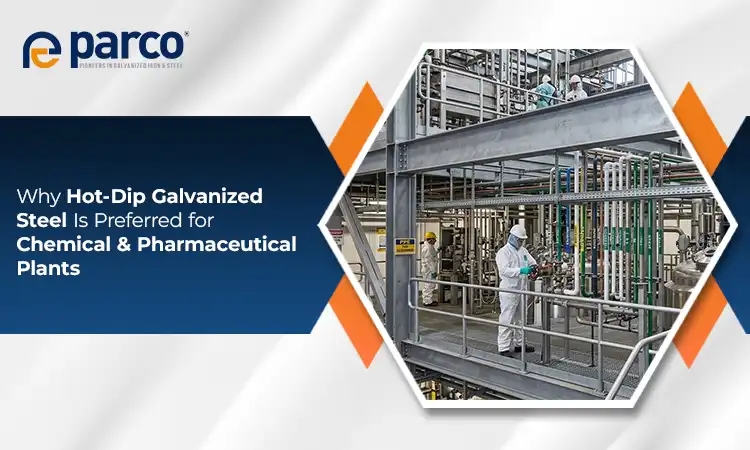
In a chemical or pharmaceutical plant, corrosion is more than a surface problem—it can turn maintenance work into an operational challenge.
Humidity, industrial atmospheres, chemical exposure, and demanding utility environments can gradually attack exposed steel.
The right material choice can therefore influence maintenance requirements, asset life, and the reliability of supporting infrastructure.
This is exactly where galvanized steel comes into the picture.
But where does it fit in a chemical or pharmaceutical facility, and what should engineers consider before specifying it?
This blog guide is going to help EPC contractors, plant owners, and project engineers understand the importance of hot-dip galvanization in chemical and pharmaceutical plants.
1. Corrosion Protection Where Plants Need It Most
Chemical and pharmaceutical facilities can contain humid areas, process emissions, outdoor utilities, and industrial atmospheres that accelerate corrosion.
Hot-dip galvanized steel provides a zinc coating that protects the underlying steel. The coating also develops protective corrosion products over time, helping slow atmospheric corrosion.
The American Galvanizers Association reports that properly specified HDG steel can provide 70+ years of maintenance-free corrosion protection in many atmospheric environments, depending on exposure conditions.
For plant owners, this means corrosion protection is built into the steel component rather than relying entirely on repeated site-applied maintenance coatings.
2. Long Service Life Supports Lifecycle Planning
Chemical and pharmaceutical plants are designed for long-term operation.
Replacing structural support, cable-management components, or access systems, prematurely can create additional engineering, labour, and shutdown costs.
Hot-dip galvanized steel is designed for long-term corrosion protection.
But actual performance depends on the environment, coating specifications, and exposure conditions.
3. Less Maintenance-and Fewer Hard-to-Reach Repairs
Maintenance becomes particularly difficult when steel components are installed above production areas, pipe racks, service corridors, or equipment zones.
Repainting elevated structures can require scaffolding, access equipment, surface preparation, and labour. Galvanized steel can reduce the frequency of such coating-maintenance interventions because corrosion protection is applied before the component reaches the plant.
This is especially relevant for plant infrastructure galvanized steel, where access for future maintenance may be restricted.
4. Built for Humid and Industrial Conditions
Humidity is a common corrosion driver around industrial utilities, cooling systems, ventilation areas, and outdoor plant infrastructure.
HDG performs well across many atmospheric environments, although its service life varies with humidity, pollution, chlorides, and other exposure factors.
For chemical plants located in coastal or industrial regions, engineers should evaluate the specific atmospheric classification rather than assume identical performance everywhere.
5. Helps Reduce Operational Disruption
Corrosion-related repair is rarely limited to replacing one piece of steel.
Work may require isolating an area, arranging access, moving equipment, or coordinating with production teams.
In pharmaceutical facilities, maintenance also operates within controlled procedures and quality systems.
WHO guidance highlights the importance of controlled maintenance and preventive maintenance for pharmaceutical HVAC systems.
https://www.who.int/docs/default-source/medicines/norms-and-standards/guidelines/production/trs1010-annex8-who-gmp-heating-ventilation-airconditioning.pdf?sfvrsn=c77698e2_0
Choosing durable materials for supporting infrastructure can therefore help reduce the frequency of disruptive maintenance interventions.
6. A Practical Choice for Cable Management Systems
GI Cable trays support electrical infrastructure, and they are essential but often overlooked when specifying corrosion protection.
Galvanized cable trays and support systems can provide durable protection for electrical and instrumentation infrastructure, particularly in industrial and outdoor areas.
For EPC contractors, specifying corrosion-resistant cable-management components can help create a more consistent material strategy across the plant.
7. Suitable for HVAC & Ventilation Supports
HVAC is critical in pharmaceutical manufacturing.
WHO guidance states that HVAC systems help establish suitable conditions for manufacturing pharmaceutical products and recommends risk-based consideration of HVAC design and utilities.
Galvanized steel can be used for suitable HVAC support structures, frames, brackets, and associated infrastructure where the exposure conditions and project specifications permit.
8. Useful Across Wider Plant Infrastructure
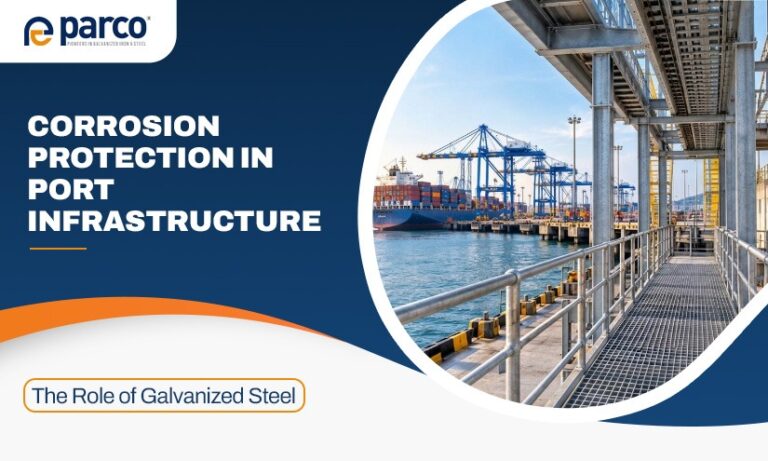
The application is not limited to one component. Depending on engineering requirements, galvanized steel can be used for platforms, handrails, gratings, structural supports, cable trays, equipment supports and utility infrastructure.
This versatility makes hot-dip galvanized steel relevant to EPC projects where multiple secondary steelwork requirements must be coordinated.
9. Consistent, Standard-Based Coating Requirements
Quality control matters when specifying corrosion protection.
ISO 1461:2022 defines general properties and test methods for hot-dip galvanized coatings on fabricated iron and steel articles, including requirements covering coating thickness, adhesion, and acceptance inspection.
ASTM A123/A123M-24 is another active specification covering zinc coatings on many iron and steel products, including fabricated structural steel.
Using recognised specifications gives project teams measurable requirements rather than relying only on visual appearance.
10. Better Material Planning for the Plant Lifecycle
The tenth reason is lifecycle-oriented material selection.
Instead of considering only purchase price, plant owners and EPC teams can evaluate corrosion protection, expected maintenance, accessibility, replacement requirements, and operational disruption together.
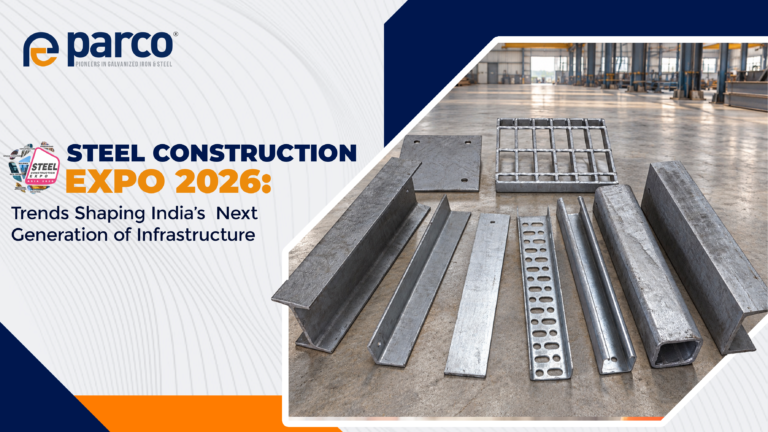
Parco Engineers is a manufacturer and supplier of Hot Dip Galvanized Steel products and fabricated structures, serving industrial sectors across India. Its product range includes GI cable trays, GI gratings, GI handrails, structural supports, angles, channels, beams, chequered plates, base plates, earthing products, and custom fabricated galvanized structures.
11. Parco Engineers’ Galvanized Steel Solutions for Chemical & Pharmaceutical Plants
For chemical and pharmaceutical plant projects, Parco Engineers is a manufacturer and supplier of Hot Dip Galvanized Steel products and fabricated structures, serving industrial sectors across India.
Its product range includes galvanized steel components and fabricated solutions suitable for plant infrastructure, utility areas, access systems, cable management, structural supports, and earthing applications.
Parco Engineers offers:
- GI Cable Trays – Perforated and ladder-type cable trays
- GI Handrails – For platforms, walkways, and access areas
- GI Walkway Gratings – For industrial platforms and maintenance access
- GI Structural Supports – Fabricated supports for plant infrastructure
- GI Angles, Channels & Beams – For structural and utility applications
- GI Chequered Plates & Base Plates – For platforms, equipment supports, and structural applications
- GI Earthing Flats, Rods & Plates – For electrical earthing infrastructure
- Custom Fabricated Galvanized Structures – Fabricated according to project-specific requirements
For EPC contractors and plant owners, having multiple galvanized steel requirements coordinated through an experienced manufacturer can simplify material planning and help maintain consistency across the project.
Ready Availability to Support Project Schedules
Project schedules can be affected when commonly required steel components have long procurement lead times. Parco Engineers maintain a wide range of galvanized steel products and fabricated structures to support project requirements and help reduce procurement delays.
Commonly required products, such as GI angles, channels, beams, base plates, chequered plates, cable trays, and gratings, are available in ready stock, depending on the required specifications and project requirements.
For chemical and pharmaceutical plant projects, this availability can help EPC contractors plan procurement more efficiently and keep installation activities aligned with project schedules.
An Important Chemical-Exposure Consideration
Hot-dip galvanized steel is not automatically suitable for every chemical environment. Chemical concentration, pH, temperature, aeration, agitation, and exposure conditions can significantly affect zinc corrosion.
The American Galvanizers Association notes that HDG generally performs well in many chemical solutions, but suitability must be assessed for the specific chemical and operating conditions.
For direct product-contact or highly aggressive chemical applications, the material should therefore be selected through project-specific engineering and compatibility assessment.
Conclusion: Is Your Plant Infrastructure Designed for the Long Run?
For chemical and pharmaceutical plants, hot-dip galvanized steel can combine corrosion protection, long service life, reduced maintenance requirements, and practical application across cable management, HVAC supports, and wider plant infrastructure.
Whether you are building a new chemical plant, expanding a pharmaceutical facility, or upgrading existing infrastructure, selecting the right corrosion protection system can significantly impact long-term maintenance costs and asset life.
Parco Engineers manufactures and supplies a wide range of Hot Dip Galvanized Steel products and fabricated structures for industrial projects across India, helping EPC contractors and plant owners build infrastructure designed for long-term performance.
From GI cable trays, handrails, gratings, structural supports, and galvanized steel sections to earthing products and custom fabricated structures, Parco Engineers can support diverse galvanized steel requirements for industrial projects.
When planning your next chemical or pharmaceutical project, are you evaluating steel based only on initial cost or on its complete lifecycle performance?
Frequently Asked Questions
1. Which chemical is used for galvanizing?
Molten zinc is used to coat steel in hot-dip
galvanizing. Zinc chloride and ammonium chloride are commonly used in the fluxing stage.
2. Is galvanized steel suitable for pharmaceutical plants?
It can be suitable for selected infrastructure such as handrails, platforms, cable trays, and supports, subject to the specific application and GMP requirements.
4. Can galvanized steel be used around chemicals?
Yes, in a suitable environment. Chemical concentration, pH, temperature, and exposure conditions should be reviewed because aggressive chemicals can accelerate zinc corrosion.
5. Does galvanized steel require maintenance?
Its corrosion-protection system can substantially reduce the frequency of maintenance compared with systems requiring regular repainting, but inspection and maintenance should still follow the project’s asset-management requirements.
6. Is hot-dip galvanized steel resistant to all chemicals?
No. Chemical compatibility depends on factors including chemical type, concentration, pH, temperature and exposure conditions. Specific chemical exposure should be assessed before selection.
6. Which standards are relevant to hot-dip galvanized steel?
ASTM A123/A123M and EN ISO 1461 are important standards for specifying hot-dip galvanized coatings on fabricated steel products.