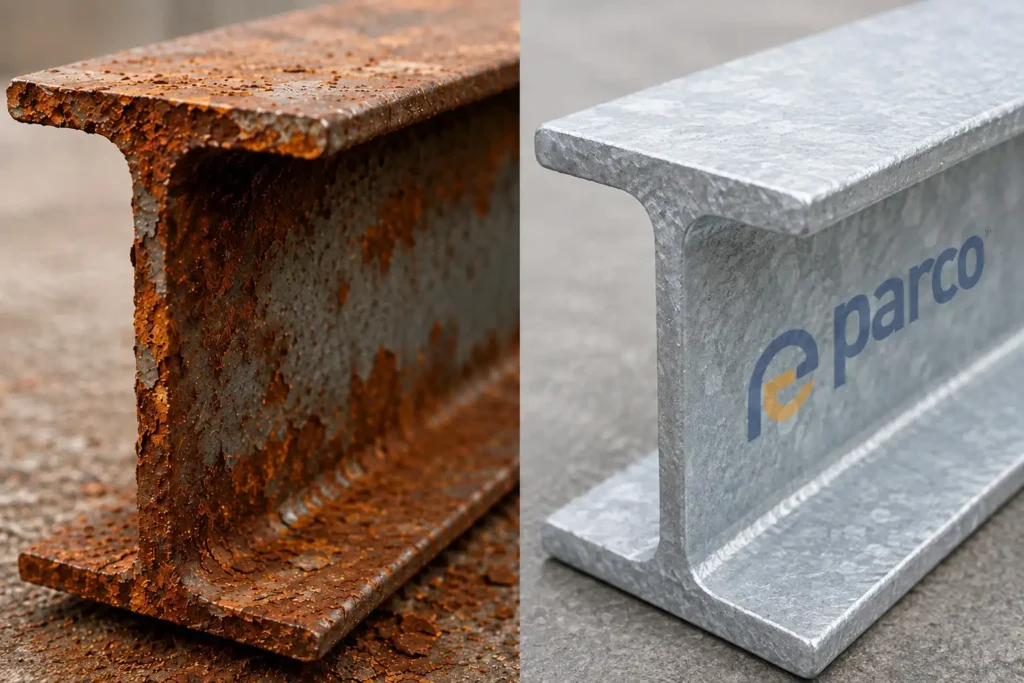
Galvanized steel has become one of the most trusted materials across India’s construction, infrastructure, manufacturing, and engineering industries. Its popularity comes from a simple yet powerful advantage: exceptional resistance to corrosion. By coating steel with a layer of zinc, the galvanization process protects it from rust and significantly extends its service life, even in demanding environments.
India’s climate brings unique challenges for steel structures. Heavy monsoon rains, high humidity, coastal salt-laden air, industrial pollution, and fluctuating temperatures all accelerate corrosion in unprotected steel. Over time, this can lead to structural deterioration, frequent maintenance, and costly replacements. Galvanized steel addresses these challenges by combining a physical barrier with sacrificial protection, making it a durable, low-maintenance, and cost-effective solution for long-term performance.
As demand for long-lasting infrastructure continues to grow, Galvanized Steel in India has become the preferred material for residential, commercial, industrial projects. As a trusted galvanized steel company in India, we are helping to drive this transformation by delivering high-quality hot dip galvanized steel solutions that comply with Indian and international quality standards, ensuring superior durability, reliability, and long-term performance across diverse applications.
Whether you’re an engineer, architect, contractor, manufacturer, or project owner, understanding galvanized steel is essential for making informed material choices. In this comprehensive guide, we’ll cover everything from the galvanization process and different types of galvanized steel to its properties, Indian standards, benefits, limitations, and applications across a wide range of industries, helping you choose the right Industrial Steel solutions for long-lasting performance, durability, and corrosion resistance.
Galvanized steel is mild steel coated with a protective layer of zinc to prevent corrosion and extend its lifespan. During the galvanization process, the zinc coating forms a strong metallurgical bond with the steel surface, creating a durable coating and corrosion resistant steel that withstands harsh weather and corrosive environments.
Unlike ordinary painted steel, galvanized steel offers two levels of protection:
The zinc coating acts as a protective shield, preventing moisture, oxygen, and other corrosive elements from coming into direct contact with the steel surface.
One of galvanized steel’s greatest advantages is that zinc corrodes before steel. Even if the coating is scratched or damaged, the surrounding zinc continues protecting the exposed steel by sacrificing itself. This unique property helps prevent rust from spreading and significantly increases the life of the structure.
Because of this dual protection mechanism, galvanized steel remains one of the most reliable and economical corrosion-resistant materials used around the world.
Whether you are searching for a Galvanized Steel Supplier Near Me or a reliable Steel Fabrication Company in India, choosing a manufacturer with proven galvanizing expertise ensures long-term structural performance.
Corrosion is a natural electrochemical process in which steel reacts with moisture, oxygen, and environmental contaminants, gradually forming iron oxide-commonly known as rust.
Although rust may initially appear to be only a surface issue, it gradually weakens the steel, reduces its load-bearing capacity, compromises structural integrity, and increases maintenance and replacement costs.
Corrosion begins when four essential elements come together:
These elements create tiny electrochemical cells on the steel surface. Iron atoms lose electrons and slowly convert them into rust, which continues spreading over time.
Unlike zinc, rust is porous and flaky. Instead of protecting the metal beneath, it exposes fresh steel to the environment, allowing corrosion to continue unless adequate protection is provided.
Cities such as Mumbai, Chennai, Kochi, and Visakhapatnam experience high salt concentrations in the air. Salt accelerates electrochemical reactions, making steel structures near the coast particularly vulnerable to corrosion.
Extended periods of rainfall keep steel surfaces continuously wet, creating ideal conditions for oxidation and rust formation.
Factories and industrial zones release sulfur dioxide, chlorides, and other corrosive chemicals that significantly increase corrosion rates.
Many parts of India experience humidity levels above 70%, allowing moisture to remain on steel surfaces for longer periods and accelerating corrosion.
Repeated cycles of heating and cooling cause steel to expand and contract. These movements can allow moisture to penetrate protective layers, increasing the risk of corrosion over time.
Several environmental and operational factors determine how quickly steel corrodes:
Understanding these factors enables engineers and project planners to choose the right corrosion protection system for each application and environment.
Corrosion is much more than an engineering concern-it is a significant economic challenge. Every year, industries and governments spend enormous amounts repairing, replacing, and maintaining steel structures damaged by rust. These costs extend beyond maintenance budgets, affecting productivity, operational efficiency, public safety, and the overall lifespan of critical infrastructure.
For a rapidly developing country like India, where new highways, railways, bridges, ports, industrial facilities, renewable energy projects, and urban infrastructure are being built at an unprecedented pace, effective corrosion protection is no longer optional. It is a long-term investment that helps reduce lifecycle costs, improve asset reliability, and maximize infrastructure value.
Key Statistics
By extending the lifespan of steel and reducing the need for frequent maintenance and replacement, galvanized steel provides one of the most practical, economical, and sustainable solutions for protecting India’s growing infrastructure.
Today, structural steel and industrial Steel protected through galvanization are widely preferred because of their superior durability, making them ideal for numerous galvanized steel applications across infrastructure and manufacturing. As a leading Galvanized Steel Supplier and Galvanized Structure Manufacturer, Parco Engineers delivers corrosion-resistant solutions for demanding industrial applications.
Galvanized steel has become the material of choice across construction, infrastructure, manufacturing, and industrial sectors because it combines the strength of steel with long-lasting corrosion protection. Unlike uncoated steel, which is vulnerable to rust, galvanized steel is protected by a durable zinc coating that extends its service life and reduces maintenance requirements.
Whether used in bridges, factories, warehouses, solar structures, or transmission towers, galvanized steel delivers reliable performance in challenging environments while offering excellent value over its entire lifecycle.
The zinc coating acts as a protective shield, preventing moisture, oxygen, industrial pollutants, and salt from reaching the steel surface. This makes galvanized steel highly resistant to rust and suitable for both indoor and outdoor applications, including coastal and high-humidity regions.
With the right coating thickness and proper environmental conditions, galvanized steel can deliver several decades of dependable performance. Its long lifespan reduces the need for frequent repairs and replacements, making it a smart investment for long-term projects.
Unlike painted steel, galvanized steel requires very little maintenance. It typically eliminates the need for regular repainting, reducing inspection, repair, and maintenance costs throughout the structure’s lifespan.
Although galvanization adds an initial processing cost, the long-term savings are substantial. Lower maintenance expenses, fewer replacements, and an extended service life make galvanized steel one of the most economical corrosion-protection solutions available.
Both steel and zinc are 100% recyclable without losing their properties. By increasing the lifespan of steel products and reducing material waste, galvanized steel supports sustainable construction and environmentally responsible manufacturing.
Among the various galvanizing methods, Hot Dip Galvanizing (HDG) is widely regarded as the industry benchmark for structural steel. It produces a thick, metallurgically bonded zinc coating that delivers outstanding durability and long-term corrosion resistance.
The process involves seven carefully controlled stages:
Steel is immersed in a caustic cleaning solution to remove oil, grease, paint, dirt, and other contaminants left behind during fabrication.
The cleaned steel is rinsed with water to stop the degreasing reaction and prevent contamination of the next treatment stage.
The steel is submerged in an acid bath, typically containing hydrochloric or sulfuric acid, to remove mill scale, rust, and oxidation. This exposes a clean steel surface for proper zinc bonding.
The steel is submerged in an acid bath, typically containing hydrochloric or sulfuric acid, to remove mill scale, rust, and oxidation. This exposes a clean steel surface for proper zinc bonding.
The steel is dipped into a zinc ammonium chloride solution. Flux prevents oxidation before galvanizing and ensures the molten zinc bonds uniformly to the steel surface.
The prepared steel is immersed in molten zinc at approximately 450°C (842°F). During this stage, zinc reacts with the steel to form multiple zinc-iron alloy layers, creating an exceptionally durable protective coating.
Finally, the galvanized steel is rapidly cooled in a quench tank. A passivation treatment helps protect the fresh coating from white rust (wet storage stain) during storage, transportation, and initial exposure
Different galvanizing methods are designed to meet specific performance, fabrication, and application requirements
Hot-dip galvanized steel provides the thickest zinc coating and the highest level of corrosion protection. It is widely used in bridges, transmission towers, industrial buildings, highways, and other outdoor infrastructure.
Electro-galvanized steel has a thinner, more uniform coating with an excellent surface finish. It is commonly used in automotive components, home appliances, and products that require painting.
Galvannealed steel is produced by heat-treating galvanized steel immediately after coating. The resulting zinc-iron alloy layer offers excellent weldability and superior paint adhesion, making it ideal for automotive and fabricated products.
Pre-galvanized steel is coated while still in coil form before fabrication. It is commonly used for cable trays, ducts, purlins, light structural sections, and HVAC systems.
Galvalume steel uses a zinc-aluminium alloy coating instead of pure zinc. This provides enhanced corrosion resistance and excellent heat reflectivity, making it a popular choice for roofing and cladding applications.
Unlike manufacturers offering multiple coating methods, Parco Engineers specializes exclusively in Hot Dip Galvanized Steel, the most durable galvanizing process for structural steel. As an experienced Hot Dip Galvanized Steel Manufacturer, Galvanized Steel Supplier, and Galvanized Structure Manufacturer, the company delivers heavy-duty corrosion protection for infrastructure, industrial, transmission, renewable energy, and fabrication projects.
Like every engineering material, galvanized steel offers several advantages while also having certain application-specific limitations.
The zinc coating continues protecting the steel even when small scratches or minor surface damage occur.
Galvanized steel delivers decades of reliable performance, significantly extending the lifespan of structures and equipment.
Minimal maintenance requirements reduce inspection, repair, and operating costs over the life of the project.
Because the zinc coating forms a metallurgical bond with the steel, it is more resistant to abrasion and mechanical damage than conventional paint systems.
Although the initial cost is slightly higher than bare steel, the reduced maintenance and replacement costs make galvanized steel highly economical over its lifecycle.
Galvanized steel is fully recyclable, supporting environmentally responsible construction and manufacturing practices.
While galvanized steel performs exceptionally well in most environments, a few considerations should be kept in mind:
Understanding these factors helps engineers choose the right corrosion protection system for each application.
Selecting the right material depends on environmental exposure, expected service life, maintenance requirements, and project budget.
Feature | Galvanized Steel | Mild Steel |
|---|---|---|
Corrosion Resistance | Excellent | Poor |
Initial Cost | Moderate | Low |
Maintenance | Low | High |
Service Life | Long | Short |
Strength | High | High |
Outdoor Applications | Excellent | Limited |
For many industrial and infrastructure projects, galvanized steel offers the ideal balance of durability, corrosion resistance, and affordability. It delivers performance close to stainless steel while remaining significantly more cost-effective than many alternative materials.
Thanks to its strength, durability, and corrosion resistance, galvanized steel is used across a wide range of industries throughout India.
Modern galvanized steel applications span virtually every sector where structural steel and industrial steel require long-term corrosion protection and minimal maintenance.
Structural frameworks, roofing sheets, purlins, staircases, handrails, guardrails, warehouses, and industrial buildings rely on galvanized steel for long-lasting structural integrity.
Transmission towers, substations, switchyard structures, and utility poles require heavy-duty galvanized coatings to ensure reliable performance over decades of outdoor service.
Farm fencing, irrigation systems, greenhouses, grain storage facilities, and livestock equipment benefit from galvanized steel’s excellent resistance to moisture, fertilizers, and agricultural chemicals.
Vehicle manufacturers use galvanized steel in body panels, chassis components, and structural assemblies to improve corrosion resistance and extend vehicle life.
Water treatment plants, storage tanks, pipelines, cable trays, and support structures depend on galvanized steel to withstand constant exposure to moisture and corrosive industrial environments.
Communication towers, antenna structures, cable management systems, and equipment supports use galvanized steel to ensure dependable long-term performance in outdoor installations.
For many industrial and infrastructure projects, galvanized steel offers the ideal balance of durability, corrosion resistance, and affordability. It delivers performance close to stainless steel while remaining significantly more cost-effective than many alternative materials.
India is undergoing one of the world’s largest infrastructure transformations. Flagship initiatives such as PM Gati Shakti, the National Infrastructure Pipeline (NIP), Bharatmala Pariyojana, Sagarmala Programme, the Smart Cities Mission, and the rapid expansion of renewable energy are driving unprecedented demand for durable construction materials. Together, these projects encompass thousands of kilometres of highways, railways, ports, airports, industrial corridors, and urban infrastructure.
To support assets expected to last for decades, engineers and project developers need materials that offer strength, reliability, and minimal maintenance. This is where galvanized steel stands out. Its superior corrosion resistance helps protect critical infrastructure from India’s diverse environmental conditions, reducing maintenance requirements and lowering total lifecycle costs.
Today, galvanized steel plays a vital role in the development of:
As India continues to invest in modern, resilient, and sustainable infrastructure, the demand for high-quality galvanized steel is expected to grow even further.
The quality and durability of galvanized steel largely depend on following established manufacturing and testing standards. Choosing products that comply with recognized Indian and international specifications ensures consistent coating quality, long-term corrosion protection, and reliable performance.
When selecting a galvanizing partner, compliance with these standards is a strong indicator of quality, consistency, and long-term performance.
India is home to numerous galvanized steel companies in India, ranging from large steel manufacturing companies in India to specialized galvanized steel manufacturers serving infrastructure, construction, renewable energy, and industrial sectors. Choosing the right manufacturing partner ensures superior corrosion protection, reliable quality, and compliance with national and international standards.
When evaluating galvanized steel manufacturing plant or manufacturers in India, consider the following factors:
Modern galvanizing facilities with efficient production capabilities.
Ability to process long and heavy fabricated steel structures.
Ensures durable and uniform zinc coating for enhanced corrosion resistance.
Coating thickness, adhesion, and visual inspections for consistent quality.
Adherence to Indian and international galvanizing standards.
Expertise in handling diverse industrial and infrastructure projects.
Controlled galvanization process for uniform, long-lasting coatings.
India is home to numerous galvanized steel companies in India, ranging from large steel manufacturing companies in India to specialized galvanized steel manufacturers serving infrastructure, construction, renewable energy, and industrial sectors. Choosing the right manufacturing partner ensures superior corrosion protection, reliable quality, and compliance with national and international standards.
When evaluating galvanized steel manufacturing plant or manufacturers in India, consider the following factors:
India is home to numerous galvanized steel companies in India, ranging from large steel manufacturing companies in India to specialized galvanized steel manufacturers serving infrastructure, construction, renewable energy, and industrial sectors. Choosing the right manufacturing partner ensures superior corrosion protection, reliable quality, and compliance with national and international standards.
When evaluating galvanized steel manufacturing plant or manufacturers in India, consider the following factors:
Galvanized steel has become one of the most dependable materials for protecting steel against corrosion, making it indispensable across India’s construction, infrastructure, manufacturing, power, and renewable energy sectors. Its combination of durability, low maintenance, and long service life offers significant economic value, particularly in environments exposed to moisture, pollution, and harsh weather.
As India continues to build world-class infrastructure, the importance of corrosion-resistant materials will only increase. Investing in high-quality galvanized steel not only improves structural reliability but also reduces lifecycle costs and supports more sustainable development.
Whether you’re designing a bridge, installing a solar power plant, constructing an industrial facility, or developing urban infrastructure, choosing galvanized steel manufactured to recognized industry standards is a smart investment in long-term performance. And when quality matters, partnering with an experienced hot-dip galvanizing specialist like Parco Engineers ensures your projects are built to last.
Galvanized steel is highly resistant to rust because the zinc coating protects the underlying steel. Over time, the zinc coating gradually corrodes before the steel becomes exposed.
Its lifespan depends on coating thickness and environmental conditions. In many environments, galvanized steel can provide several decades of reliable corrosion protection.
Yes. However, appropriate ventilation and safety measures should be followed to minimise exposure to zinc fumes during welding.
Yes. Galvanized steel can be painted after proper surface preparation, creating a duplex coating system that offers even greater corrosion protection.
Yes, although coastal environments are more corrosive due to salt exposure. Selecting an appropriate coating thickness is essential for achieving the desired service life.
Construction, infrastructure, power transmission, solar energy, telecommunications, automotive, agriculture, water treatment, and industrial manufacturing all rely heavily on galvanized steel.
Yes. Both steel and zinc are recyclable, and the extended lifespan of galvanized products helps reduce material consumption and maintenance over time.
Partner with Parco Engineers for high-quality, durable, and performance-driven solutions tailored to your project needs




























[forminator_form id=”2481″]
[forminator_form id=”2481″]