Imagine a commercial parking facility installing 20 EV charging points. The chargers are connected, electrical systems are operational, and the site is ready for use.
However, the infrastructure surrounding these chargers must withstand years of rainfall, humidity, vehicle movement, and outdoor exposure. Corrosion in cable supports, mounting structures, or electrical components can lead to recurring maintenance and additional project costs.
This is an important consideration as India’s electric mobility ecosystem expands. According to the Ministry of Heavy Industries, India had 52,718 public EV charging stations as of July 2026, including 16,561 stations equipped with fast chargers for cars. This growing network increases the need for durable supporting infrastructure that can perform reliably in different environmental conditions.
One material that addresses several of these requirements is Galvanized steel. With its zinc-based protective coating, structural strength, and suitability for outdoor applications, it plays an important role in developing reliable EV charging facilities.
Understanding EV Charging Station Infrastructure
An EV charging station involves much more than charging equipment. It requires several supporting infrastructure components to ensure safe, organised and efficient operation.
Some of the important components include:
- Charging equipment and mounting structures for EV chargers.
- Electrical distribution panels and associated support structures.
- Cable trays and cable management systems for organised cable routing.
- Earthing and grounding arrangements for electrical safety.
- Solar panel mounting structures in renewable energy-powered charging facilities.
- Structural foundations, base plates and supporting frameworks.
Each of these components must be designed to withstand the operating conditions of the installation. Selecting appropriate materials and corrosion protection systems becomes particularly important for outdoor and long-term infrastructure projects.
Why Does EV Charging Station Infrastructure Need Galvanized Steel?
An EV charging facility involves more than charging equipment. It includes cable management systems, electrical supports, protective barriers, solar installations, earthing arrangements and structural foundations.
These components are frequently exposed to rain, moisture, dust, pollution and temperature variations. Unprotected steel can gradually rust, affecting its appearance, structural integrity and maintenance requirements.
Galvanized steel structures provide a practical solution by combining the strength of steel with corrosion protection. The zinc coating acts as a protective barrier and provides sacrificial protection, helping safeguard the underlying metal when minor coating damage occurs.
For project developers and EPC contractors, this means selecting materials that can support long-term infrastructure performance rather than focusing only on initial installation costs.
5 Important Applications of Galvanized Steel in EV Charging Infrastructure
1. Galvanized Cable Trays for Safe Cable Management
Cable management is a critical requirement in EV charging facilities. Multiple charging points require organised routing for power cables, control cables and associated electrical connections.
Galvanized cable trays provide mechanical support and organised pathways for electrical cables across parking facilities, charging hubs and industrial installations.
Hot dip galvanized steel trays are particularly useful in outdoor environments because their protective coating helps resist corrosion caused by moisture and atmospheric exposure.
For example, perforated cable trays can support cable routing and ventilation, while ladder-type trays are suitable for installations requiring accessible cable support. The tray design, load capacity, spacing and electrical clearances should always match the project specifications.
2. Solar Panel Structures for Renewable EV Charging
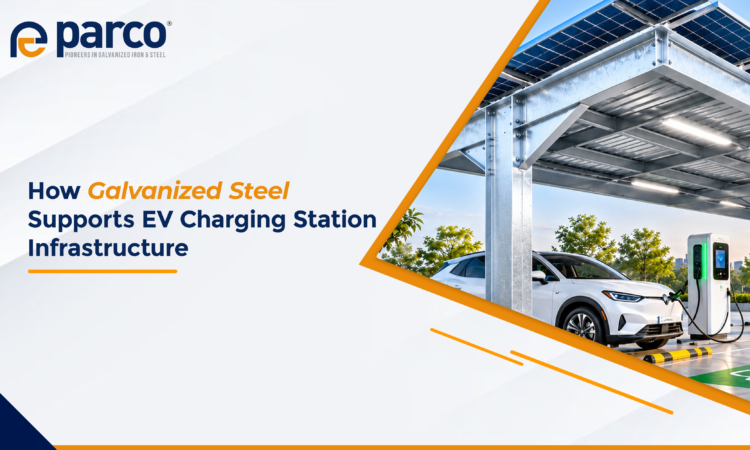
Solar-powered EV charging facilities combine renewable electricity generation with vehicle charging infrastructure. These installations require structural frameworks capable of supporting solar modules while withstanding outdoor weather conditions.
A solar panel structure can incorporate galvanized square pipes, Beams, round pipes, channels, slotted angles and other fabricated steel components.
These components support the mounting framework, roof arrangement, and structural bracing. Their corrosion-resistant finish helps protect exposed members against environmental deterioration.
For EPC contractors, selecting the correct material grade, structural dimensions, zinc coating specification, and foundation arrangement is essential for reliable performance.
3. GI Earthing Materials for Electrical Safety
Electrical safety is fundamental to every EV charging installation. Proper earthing arrangements help provide a controlled path for fault current and support the overall electrical protection system.
GI earthing flats, rods and round bars are used in suitable earthing applications depending on the electrical design and site requirements.
A Galvanized steel earthing component offers corrosion protection that is particularly valuable when installed in soil or exposed outdoor conditions. However, soil resistivity, moisture, chemical composition, and electrical design must determine the appropriate material and specifications.
4. Mounting Structures and Electrical Equipment Supports
Charging stations require stable mounting arrangements for chargers, distribution panels, junction boxes and associated equipment.
EV charging station mounting structures can be manufactured using galvanized plates, angles, channels, beams and fabricated sections.
These Galvanized steel mounting structures offer mechanical strength and corrosion protection for outdoor installations. Properly designed base plates, anchor bolts and support frames also help distribute equipment loads safely.
Hot-Dip Galvanizing vs Painted Steel: Which Is Better?
Both painting and galvanizing protect steel against corrosion, but their protective mechanisms differ.
In Hot dip galvanized steel, fabricated steel is immersed in molten zinc, creating metallurgically bonded zinc-iron alloy layers and an outer zinc layer. This provides barrier protection as well as sacrificial protection.
Painted steel primarily relies on an intact surface coating. Scratches, impact damage or coating deterioration can expose the underlying metal to moisture and accelerate corrosion.
| Comparison factor | Hot-dip galvanized steel | Painted steel |
| Protection | Barrier and sacrificial protection | Primarily barrier protection |
| Coating bond | Metallurgically bonded | Surface-applied coating |
| Damage resistance | Durable zinc coating | Depends on paint system and application |
| Maintenance | Generally lower in suitable environments | May require periodic inspection and repainting |
| Outdoor suitability | Suitable with correct coating specification | Depends on coating quality and exposure |
For outdoor EV installations, Corrosion resistant steel protection through galvanizing can offer lifecycle advantages. A duplex system, combining galvanizing and paint, may also be considered where additional protection or a specific appearance is required.
Lifecycle Cost Benefits of Galvanized Steel
When selecting materials for infrastructure projects, the initial purchase price should not be the only consideration. The overall lifecycle cost of a product includes installation, maintenance, inspection and potential replacement expenses.
For EV charging infrastructure, galvanized steel can offer several advantages:
- Reduced Maintenance: Zinc coatings provide durable corrosion protection, helping reduce recurring maintenance requirements in suitable environments.
- Lower Repainting Requirements: Unlike conventional painted steel systems, hot dip galvanized components generally do not require periodic repainting as part of their normal corrosion protection.
- Long-Term Performance: Properly specified galvanized steel can help reduce the risk of premature corrosion-related replacement.
- Reduced Operational Disruptions: Lower maintenance requirements can help minimise interruptions caused by repair and replacement activities.
How to Select the Right Galvanized Steel for EV Projects
Before procurement, project engineers and purchase managers should evaluate these factors:
- Zinc coating thickness: Specify coating requirements according to the product thickness, applicable standard and environmental exposure.
- Material strength: Select suitable steel grades and dimensions according to structural loads and engineering calculations.
- Environmental conditions: Consider coastal exposure, industrial pollution, rainfall, humidity and soil conditions.
- Fabrication quality: Check welding, drilling, venting and drainage arrangements before galvanizing.
- Quality standards: Refer to applicable specifications such as IS 4759, IS 2629, ASTM A123 and ISO 1461, depending on the product and project requirements.
- Lifecycle cost: Compare procurement, installation, inspection, maintenance and replacement costs rather than evaluating initial material price alone.
The Bureau of Indian Standards identifies IS 4759 as the specification for hot-dip zinc coatings on structural steel and other allied products. Project teams should verify the applicable coating requirements and testing documentation before accepting supplied materials.
Choosing the Right Galvanized Steel Partner for EV Infrastructure
Selecting suitable materials is only one part of developing dependable charging infrastructure. Consistent product quality, accurate specifications, fabrication capabilities and reliable supply are equally important for project execution.
Parco Engineers offers a range of galvanized products, including hot-dip galvanized perforated and ladder cable trays, earthing flats, earthing rods, round bars, plates, angles, channels, beams, square pipes, round pipes and Unistrut channels.
These products can support different requirements across EV charging facilities, from electrical cable management and earthing arrangements to solar frameworks and structural supports.
As a Galvanized steel manufacturer and fabricator, Parco Engineers provides product solutions for infrastructure and industrial applications. Project developers can evaluate its product range against their technical drawings, material grades, coating requirements and installation specifications.
Explore the galvanized product range to identify suitable materials for your next EV infrastructure project.
Conclusion
The expansion of electric mobility requires charging infrastructure that can withstand outdoor exposure, support electrical safety and minimise recurring maintenance. Galvanized steel contributes to these objectives through durable cable trays, protective structures, solar frameworks, GI earthing materials and equipment supports.
Choosing the right specifications and working with experienced Galvanized steel fabricators can help EPC contractors and infrastructure developers build reliable charging facilities. As your next EV charging project takes shape, are you selecting materials that can deliver long-term performance rather than just meeting today’s installation requirements?