A port operates in one of the most demanding environments.
Salt-laden air, high humidity, moisture, chloride exposure and frequent wet-and-dry cycles continuously challenge exposed metal surfaces.
For Port authorities, EPC contractors and maintenance teams, corrosion is not an aesthetic issue—it can increase maintenance requirements, affect infrastructure reliability, and raise lifecycle costs.
As India’s ports continue to handle increasing volumes of cargo, durable corrosion protection is becoming more important.
Indian ports handled 1,6026 million tonnes of cargo in FY 2024–25, according to the Ministry of Ports, Shipping and Waterways.
Against this backdrop, selecting materials that can perform reliably in coastal conditions is a critical project consideration.
Why Corrosion Protection Matters in Ports
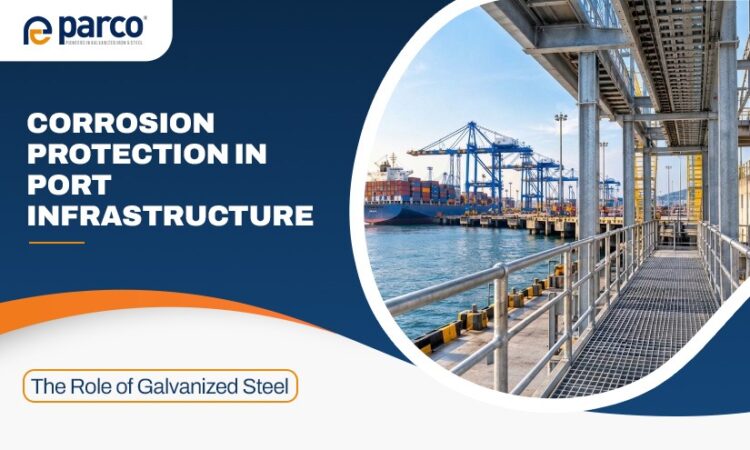
Port infrastructure includes structural support, platforms, walkways, handrails, cable support systems, gratings, and equipment frames. Many of these components remain continuously exposed to the coastal atmosphere.
Salt and moisture can accelerate corrosion of unprotected steel, eventually leading to deterioration, increased inspection requirements, repairs, and replacement. Maintenance can be challenging for elevated components, inaccessible structures or within continuously operating facilities.
For project managers and procurement teams, corrosion protection therefore needs to be considered as part of the lifecycle strategy, not just the initial construction cost.
How Galvanized Steel Can Help Protect Ports
Hot dip galvanized steel provides a zinc coating over the steel surface, acting as a protective barrier between the underlying steel and the surrounding environment.
The galvanized coating also provides sacrificial protection. If a small area of steel becomes exposed due to minor damage, the surrounding zinc can preferentially corrode and help protect the underlying steel.
This combination of barrier and sacrificial protection makes galvanized steel a practical corrosion-protection option for many atmospherically exposed port applications. However, performance depends on the actual exposure conditions, coating specifications, and required service life.
Applications of Galvanized Steel in Port Infrastructure
Galvanized components can be used in several areas of port development.
Structural and Access Systems
Galvanized structure components can be used for structural support, fabricated frames, platforms, and equipment support. GI gratings, stairs, walkways, and handrails can also provide corrosion protection in exposed access areas.
Electrical Infrastructure
Outdoor electrical systems require durable support infrastructure. GI cable trays, ladder trays, and cable support structures can help protect essential electrical installations from atmospheric exposure.
Material-Handling Systems
Ports rely heavily on conveyors and associated equipment. Galvanized support structures can help address corrosion concerns in suitable atmospheric exposure zones while reducing reliance on frequent site-applied protection.
India’s Western Coast: Port Expansion Driving Demand
India’s western coastline is seeing continued investment in port infrastructure, logistics, cargo-handling facilities, and supporting industrial development.
As new capacity is developed and existing facilities are expanded, the demand for durable steel infrastructure suited to coastal environments is also increasing.
Port Infrastructure Growth Along the Western Coast
Several major port and infrastructure developments along with India’s western coast are contributing to this growth, including:
- Vadhvan Port, Maharashtra – A major planned deep-water port development involving marine, cargo-handling, and logistics infrastructure.
- Jawaharlal Nehru Port (JNPA), Navi Mumbai – Ongoing capacity expansion, terminal development, and multimodal logistics infrastructure.
- Deendayal Port, Gujarat – Continued modernisation and development of cargo-handling and supporting infrastructure.
- Mundra Port, Gujarat – Expansion of terminals, logistics facilities, and associated industrial infrastructure.
- Hazira Port, Gujarat – Development of cargo handling, storage, and industrial support facilities.
These projects require durable steel infrastructure capable of withstanding aggressive coastal environments while supporting long service life and reduced maintenance requirements.
Galvanized Solutions for Port Infrastructure
Different areas of port infrastructure require different types of steel components. Parco Engineers offers a range of hot-dip galvanized products that can support several common applications across port, marine, industrial, and logistics infrastructure.
| Port Application | Parco Product |
| Walkways & Access Platforms | GI Chequered Plates |
| Operator & Safety Access | GI Handrails |
| Drainage & Maintenance Areas | GI Gratings |
| Electrical Infrastructure | GI Perforated Cable Trays |
| Power & Control Cabling | GI Ladder Cable Trays |
| Equipment Support Structures | GI Angles, Channels & Beams |
| Earthing Systems | GI Earthing Flats, Plates & Rods |
| Utility Structures | Fabricated Galvanized Structures |
| Boundary & Security Infrastructure | GI Fencing Angles |
Parco Engineers’ galvanized products can be specified for suitable applications based on project requirements, exposure conditions, coating specifications, and applicable standards.
Our Hot Dip Galvanized Steel products are generally manufactured with a minimum zinc coating thickness of 90 – 100 microns. Where required, coating specifications can be aligned with project requirements and the standards specified by consultants, EPC contractors, and project owners.
Real Project Example: Supporting Critical Infrastructure
Parco Engineers has supplied hot dip galvanized steel products for major infrastructure developments, demonstrating the practical application of galvanized components in demanding project environments.
One example is the BMCT / JNPT Uran Phase-II Project, where Parco Engineers supplied 100+ tonnes of GI handrails.
This project experience highlights how galvanized steel components can be incorporated into large-scale infrastructure where durability, corrosion protection, and reliable performance are important considerations.
Lifecycle and Maintenance Benefits of Galvanizing
For port operators, the benefit of Hot dip galvanizing extends beyond corrosion resistance. Maintenance can require access to equipment, labour, permits, and operational coordination. A durable galvanized zinc coating can reduce the frequency of corrosion-related repainting and repairs in suitable applications.
This can contribute to better lifecycle economics by reducing the cumulative cost of maintenance and intervention. The actual benefit depends on the exposure severity, design life, and the selected corrosion-protection system.
Galvanized Steel for Port Projects
Parco Engineers offers a range of GI products which include GI Structural Steel components, GI Chequered Plates, GI cable trays, GI steel gratings, GI handrails and GI earthing solutions that can support corrosion-conscious infrastructure design.
Our galvanized product range can be considered for applications where durable protection for exposed steel is needed.
Ultimately, effective corrosion protection is about matching the material and coating system to the environment, design life, and maintenance strategy.
For port authorities, EPC contractors and marine infrastructure teams planning long-term performance, could galvanized steel be the practical corrosion-protection solution for the right applications?
Frequently Asked Questions
What factors should be considered when selecting steel for a port project
Steel selection should consider the project’s structural requirements, exposure conditions, expected service life, fabrication needs, applicable standards, installation environment, maintenance access, and total lifecycle cost. Procurement teams should also evaluate coating specifications, supplier capabilities, quality controls, lead times, and whether the selected steel system is appropriate for the project’s operating conditions.
Why should EPC contractors involve corrosion considerations during the design stage?
Addressing corrosion during design allows the project team to select suitable galvanized materials, coatings, connection details, drainage arrangements, inspection access, and maintenance strategies before construction begins. Early decisions can help reduce avoidable maintenance challenges and ensure that the corrosion-protection approach aligns with the project’s expected service life and operating environment.
How can galvanized steel support faster infrastructure installation
Because the protective zinc coating is applied before the material reaches the project site, galvanized components can arrive ready for installation without relying entirely on-site coating work. This may simplify project coordination and reduce certain field activities, although installation schedules still depend on fabrication, transportation, site access, and project-specific requirements.
What steel components are commonly required for port construction?
Port construction can involve a wide range of steel components, including structural members, platforms, ladders, handrails, gratings, cable-support systems, equipment supports, conveyor structures, electrical supports, and earthing components. The exact requirements depend on the type of port, cargo-handling systems, marine structures, utilities, and operational infrastructure included in the project.
How can port projects reduce steel maintenance costs?
Port projects can reduce long-term steel maintenance costs through appropriate material selection, effective corrosion protection, good structural
detailing, drainage, regular inspections, and planned maintenance.
Considering lifecycle costs during the design and procurement stages can help avoid repeated repair, recoating, access, and replacement expenses after the infrastructure becomes operational.