Introduction
A reliable earthing system plays an important role in protecting electrical installations, industrial equipment, buildings, and infrastructure from electrical faults and lightning-related surges. The choice of earthing conductor may play an important role and have a direct influence on the system’s durability, maintenance requirements, and long-term performance.
There are two common options: GI earthing strips and copper strips.
While copper is known for its excellent electrical conductivity, hot dip galvanized steel offers a combination of mechanical strength, corrosion protection, durability, and cost efficiency.
But which material is better for a particular application?
The answer depends on factors such as soil conditions, installation environment, required conductivity, corrosion exposure, mechanical requirements, project budget, and applicable electrical standards.
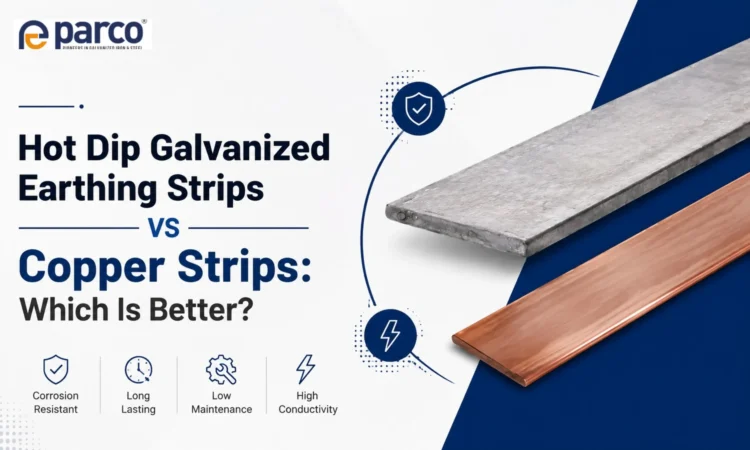
This guide compares hot dip galvanized earthing strips vs copper strips to help engineers, contractors, and project owners make a more informed choice.
What Is a GI Earthing Strip?
A GI earthing strip is a Mild steel strip protected with a zinc coating through process of Hot Dip galvanization. GI, commonly known as the galvanized iron or galvanized steel in the market, provides a protective zinc layer that helps shield the underlying steel from corrosion.
For earthing applications, galvanized strips can be installed as part of an electrical grounding network to provide a conductive path for fault current toward the earth.
The combination of steel’s mechanical strength and the protective galvanized coating makes GI strips suitable for many industrial, commercial, infrastructure, and outdoor applications.
What Are Copper Earthing Strips?
Copper strips are made from copper and are widely used in electrical earthing systems because copper has very high electrical conductivity.
Copper can provide efficient current conduction while also offering good corrosion resistance in many environments. However, copper is a relatively expensive material, and its mechanical properties and compatibility with other metals need to be considered during installation.
In any project, where conductivity is the primary requirement, copper can be an attractive choice. For projects where mechanical durability, corrosion protection, and overall project economics are equally important, galvanized steel can offer a practical alternative.
Hot Dip Galvanized Earthing Strips vs Copper Strips: Key Differences
The choice between galvanized steel and copper should not be based on conductivity alone. An earthing system operates in an environment where corrosion, mechanical damage, installation conditions, and long-term maintenance can affect performance.
Here are the major factors to consider.
1. Electrical Conductivity
Copper has significantly higher electrical conductivity than steel. This means a copper strip can carry electrical current efficiently with a smaller cross-sectional area.
However, the performance of an earthing system is influenced by more than the conductivity of the conductor. Strip dimensions, connection quality, soil characteristics, installation design, and overall grounding arrangement also matter.
A properly designed GI earthing strip can therefore be suitable for applications where the required electrical performance can be achieved with the specified dimensions and system design.
2. Corrosion Resistance
Corrosion is one of the most important considerations for any earthing system installed outdoors or underground.
Hot dip galvanization protects steel by applying a metallurgically bonded zinc coating to its surface. The zinc layer provides a barrier against the surrounding environment and also offers sacrificial protection to exposed steel.
This makes hot dip galvanized steel particularly useful where earthing components may be exposed to moisture, soil, weather, or industrial environments.
Copper also has good corrosion resistance, but its behaviour depends on the surrounding environment and the presence of other metals.
3. Mechanical Strength
Steel generally provides greater mechanical strength than copper. This can be beneficial during transportation, handling, installation, and applications where the earthing strip may experience mechanical stress.
A galvanized steel strip combines the structural strength of steel with the protective properties of a zinc coating.
This can make galvanized strips useful where electrical grounding and mechanical robustness are required.
4. Durability
The durability of an earthing system depends on the material, installation environment, coating quality, soil chemistry, connections, and maintenance.
The galvanization process creates a durable zinc coating that helps protect the steel against corrosion. When properly specified and installed, galvanized earthing components can provide long-term service in many applications.
Copper can also provide long service life, but its usage should be evaluated based on the specific soil and environmental conditions.
5. Cost
Cost is another major consideration when selecting earthing material.
Copper is generally more expensive than steel because of the higher cost of the raw material. For large infrastructure, industrial, commercial, and utility projects involving substantial lengths of earthing conductors, material selection can have a noticeable impact on the project budget.
A GI earthing strip can be a more economical option where the required electrical and corrosion-performance criteria can be met through appropriate design.
However, the lowest initial material cost should not be the only selection criterion. Engineers should consider the complete lifecycle cost, including installation, maintenance, replacement, and expected service life.
6. Installation and Handling
The physical characteristics of an earthing strip can influence installation.
Galvanized steel offers good mechanical strength and can withstand handling and installation stresses. The strip can be incorporated into grounding networks according to the project’s design and applicable specifications.
Copper is softer and more malleable, which can make certain installation tasks easier, but this characteristic can also make it more susceptible to mechanical deformation.
7. Compatibility With Other Metals
Metal compatibility is an important consideration when designing an earthing system.
Direct contact between dissimilar metals can create galvanic corrosion under certain environmental conditions. Therefore, connections between galvanized steel, copper, and other metals should be properly designed using suitable connectors and installation practices.
The choice of GI earthing strip or copper should therefore consider the complete grounding system rather than treating the strip as an isolated component.
GI Earthing Strip vs Copper Strip: Comparison Table
| Factor | GI Earthing Strip | Copper Strip |
| Base material | Steel with zinc coating | Copper |
| Electrical conductivity | Lower than copper | Excellent |
| Mechanical strength | High | Comparatively lower |
| Corrosion protection | Zinc coating provides protection | Naturally corrosion resistant in many environments |
| Material cost | Generally more economical | Generally higher |
| Handling | Robust | Softer and more malleable |
| Outdoor applications | Suitable when properly specified | Suitable depending on environment |
| Maintenance | Depends on soil and installation conditions | Depends on environment and connections |
| Application suitability | Infrastructure, industrial and grounding applications | Applications requiring high conductivity |
How Hot Dip Galvanization Protects Earthing Strips
The advantage of HDG steel comes largely from its protective zinc coating.
During hot dip galvanizing, prepared steel is immersed in molten zinc. The process forms zinc-iron alloy layers bonded to the steel surface, with an outer zinc layer providing additional protection.
The resulting coating helps isolate the steel from the surrounding environment. If small areas of the coating become damaged, zinc can provide sacrificial protection to exposed steel under suitable conditions.
This protective mechanism is one reason hot dip galvanized steel is widely used in applications where corrosion resistance is important.
Why Corrosion Matters in Earthing Systems
An earthing conductor is expected to remain electrically continuous for the required service period of the installation. Corrosion can gradually reduce the effective cross-section of a conductor and potentially affect its long-term performance.
Factors such as:
- Soil moisture
- Soil chemistry
- Salt exposure
- Industrial pollutants
- Temperature
- Water drainage
- Contact with dissimilar metals
can influence corrosion behaviour.
For this reason, selecting an appropriate galvanized coating and suitable earthing material is an important part of grounding-system design.
When Should You Choose a GI Earthing Strip?
A GI earthing strip may be considered when a project requires a combination of:
- Corrosion protection
- Mechanical strength
- Long-term durability
- Cost efficiency
- Suitability for outdoor or infrastructure applications
- Compatibility with the overall grounding design
It can be particularly relevant and useful for large projects where extensive earthing networks are required, and material economics is an important consideration.
The final selection should always be based on electrical design, environmental conditions, applicable standards, and project specifications.
When Is Copper a Better Choice?
Copper can be preferred when very high electrical conductivity is required or where the electrical system has been specifically engineered around copper conductors.
It can be particularly useful when space constraints require a highly conductive material with a relatively compact cross-section.
However, copper’s higher material cost should be considered when planning large-scale grounding networks.
Which Is Better: GI Earthing Strip or Copper Strip?
There is no universal answer to whether galvanized steel or copper is better.
Copper offers superior electrical conductivity, making it an excellent conductor for applications where conductivity is the dominant consideration.
On the other hand, hot dip galvanized steel offers a strong combination of mechanical strength, corrosion protection, durability, and cost efficiency. For many infrastructure and industrial applications, this combination can make galvanized steel a practical earthing solution.
The right choice should therefore be based on the project’s electrical requirements, environmental exposure, expected service life, installation conditions, and total lifecycle cost.
Choose the Right Earthing Material for Long-Term Performance
A well-designed grounding system requires more than simply choosing a highly conductive metal. The selected material must withstand the installation environment and provide reliable performance throughout its expected service life.
GI earthing strips, when properly manufactured, galvanized, specified, and installed, can provide a durable solution for a wide range of grounding applications. Copper remains an important option where its superior conductivity justifies its higher material cost.
For engineers and project managers, the best approach is to evaluate conductivity, corrosion resistance, mechanical strength, cost, installation requirements, and applicable standards together before making a final decision.
Conclusion
The comparison between hot dip galvanized earthing strips and copper strips ultimately comes down to application requirements rather than a single performance parameter.
Copper has the advantage of higher electrical conductivity, while galvanized steel offers a compelling combination of strength, zinc-based corrosion protection, durability, and cost effectiveness.
For large-scale infrastructure and industrial applications where robust and economical earthing material is required, a properly specified GI earthing strip can be a valuable solution.
The key is to select the material, dimensions, coating, connections, and installation method according to the specific electrical and environmental requirements of the project.
Frequently Asked Questions
Is GI earthing strip better than copper?
It depends on the application. Copper offers higher conductivity, while GI offers strength, corrosion protection, and cost efficiency.
Which is more corrosion resistant, GI or copper?
Hot dip galvanized GI provides strong corrosion protection through its zinc coating, while copper also offers good corrosion resistance in many environments.
Is GI earthing strip cheaper than copper?
Yes. GI earthing strips are generally more economical than copper strips.
What are the advantages of GI earthing strips?
Key advantages include corrosion protection, mechanical strength, durability, and cost effectiveness.
Where are GI earthing strips used?
They are commonly used in industrial, commercial, infrastructure, and electrical grounding applications.
How do I choose between GI and copper earthing strips?
Consider conductivity, corrosion exposure, mechanical strength, installation conditions, cost, and project requirements.
Are GI earthing strips suitable for outdoor applications?
Yes, properly hot dip galvanized GI earthing strips can be suitable for many outdoor and exposed applications.