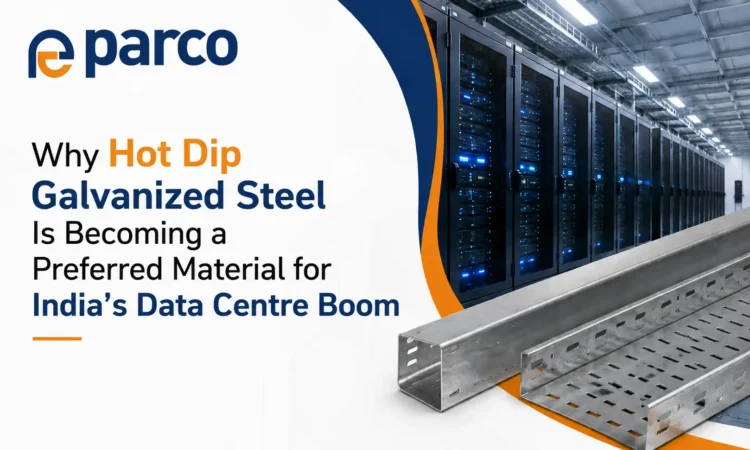
India’s data centre industry is expanding at a remarkable pace. The growth of cloud computing, AI, digital payments, streaming platforms, e-commerce and data-driven businesses is creating demand for larger and more sophisticated data centre facilities.
But building a data centre is not only about servers, racks and cooling systems. Behind that technology is a vast physical infrastructure of cable trays, equipment supports, earthing systems, HVAC supports, utility frameworks and MEP structures.
These components need to remain strong and reliable for years, often in areas that are difficult and expensive to access once a facility becomes operational.
That is why material selection matters.
Hot Dip Galvanized (HDG) Steel is increasingly being considered for these applications because it combines the structural strength of steel with durable zinc-based corrosion protection. For data centre developers, EPC contractors and infrastructure teams, that combination can translate into longer service life, lower maintenance requirements and better lifecycle value.
The Hidden Backbone of Every Data Centre
When people talk about India’s data centre expansion, the conversation usually focuses on server capacity, power consumption or cooling technology.
But every new facility also requires a considerable amount of physical support infrastructure.
Think about everything that must be installed around the equipment:
- Cable trays for power and network cables
- Supports for HVAC systems and ducts
- Equipment mounting structures
- Earthing and grounding components
- Pipe and conduit support
- Electrical frameworks
- MEP support systems
- Utility structures
- Brackets, channels and base plates
- Modular slotted angle structures
As the data centre gets bigger, these requirements increase as well.
And because many of these systems are installed above ceilings, below raised floors or around tightly packed services, replacing them later is not always straightforward. A material that can withstand the environment for a long time can therefore make a real difference to the overall maintenance burden.
Why Corrosion Deserves Attention
Corrosion is often associated with outdoor structures, factories, or coastal environments. But that does not mean indoor infrastructure is completely protected from it.
A data centre has its own set of environmental conditions. Changes in humidity, condensation around cooling equipment, utility areas, maintenance activity and long operating periods can all affect exposed metal components.
Even slow corrosion can become a problem over time.
A corroded support may need inspection, repair or replacement. In a live data centre, carrying out that work can be more complicated than it sounds. Access may be restricted, other services may be running nearby, and maintenance work must be carefully planned.
This is why corrosion protection is worth considering at the design stage rather than treating it as a maintenance issue later.
What Makes Hot Dip Galvanized Steel Different?
Hot Dip Galvanizing is a process used to protect steel from corrosion. Fabricated steel components are immersed in molten zinc, creating a protective zinc coating over the steel surface.
The coating works in two ways.
First, it acts as a barrier, separating the steel from moisture and other elements that can cause corrosion.
Second, zinc provides sacrificial protection. Where the coating is locally damaged, the surrounding zinc can help protect the exposed steel.
This is different from simply painted steel. A paint system can provide good protection when properly applied and maintained, but once the coating is damaged or begins to deteriorate, the underlying steel can become exposed.
Galvanizing provides another layer of protection that can be particularly useful for infrastructure expected to remain in place for many years.
Why Is Hot Dip Galvanized Steel Used in Data Centre Infrastructure?
Long Service Life
Data centres are not short-term construction projects. The infrastructure installed today may remain in service for decades.
Support structures that are difficult to reach after commissioning therefore need to be selected with long-term performance in mind.
Hot Dip Galvanized steel can provide durable corrosion protection, helping reduce the risk of early deterioration when the coating and material are correctly specified for the environment.
Less Maintenance
Nobody wants unnecessary maintenance inside an operating data centre.
Accessing cable support systems, HVAC structures or utility frameworks can take time and may interfere with other ongoing work. A durable galvanized coating can reduce the need for repeated coating maintenance in suitable applications.
That does not mean galvanized steel needs no inspection or maintenance at all. It simply means the material can reduce some of the maintenance associated with protecting uncoated or conventionally painted steel.
Strong and Suitable for Heavy Loads
There is a reason steel continues to be used across industrial and infrastructure projects: it can handle substantial loads without requiring excessive material.
Data centres have plenty of those loads.
Cable systems, mechanical services, equipment supports and utility installations all need properly designed structures to carry their weight safely.
Using galvanized steel allows the project to retain the structural characteristics of steel while adding corrosion protection.
A Better View of Cost
The cheapest material at the time of purchase is not necessarily the cheapest option over the life of a facility.
A proper cost comparison should also consider maintenance, repairs, recoating, replacement, and the labour involved in accessing installed components.
That is where lifecycle costs become useful.
An HDG component may cost more initially than an unprotected alternative, but the longer service life and reduced maintenance requirements can make the overall investment more attractive.
Where Is Hot Dip Galvanized Steel Used in Data Centre’s?
HDG steel can be used across many parts of a data centre, depending on the design and environmental conditions.
Cable Tray Support Systems
A data centre may have extensive networks of power, communication, fibre-optic and control cables.
Steel support systems are used to hold these cable routes in place. Galvanized steel can be used for cable tray supports, brackets, and associated frameworks where corrosion protection is required.
The combination of strength and durability makes steel a practical choice for these systems.
Equipment Support Structures
Servers and other equipment need stable and properly engineered support structures.
Galvanized steel components can be used for:
- Rack support structures
- Equipment frames
- Cabinet supports
- Cross members
- Mounting brackets
- Custom support structures
The exact design depends on equipment loads, layout and project specifications.
Earthing and Grounding Systems
Grounding is an essential part of electrical infrastructure.
Galvanized steel may be used for components such as earthing flats, rods and plates, depending on the electrical design, soil conditions and project specifications.
The zinc coating helps protect steel components from corrosion and can support long-term durability.
HVAC and Mechanical Supports
Cooling systems are one of the most important parts of any data centre.
HVAC equipment, ducts, pipes and other mechanical services all need properly designed support systems. Galvanized steel can be used for these structures because it combines load-bearing capability with corrosion protection.
Hot Dip Galvanized Slotted Angles: The Unsung Hero of Data Centre Infrastructure.
One component that deserves more attention in data centre construction is the Hot Dip Galvanized Slotted Angle.
Slotted angles are made with pre-punched holes, allowing them to be assembled using bolts and fittings. This makes them useful when a project needs support structures that can be installed quickly and modified later.
For data centres, that flexibility can be valuable.
Layouts change. New cables are added. Equipment is upgraded. Additional services may be required as a facility expands.
Instead of fabricating every support structure from scratch, modular slotted angle systems can often be adjusted or extended according to the requirement.
They can be used for:
- Cable tray supports
- Electrical panel frameworks
- Pipe and conduit supports
- Battery rack structures
- Telecom equipment supports
- Utility frameworks
- MEP supports
- Raised floor support structures
When the slotted angles are Hot Dip Galvanized, the system combines the convenience of modular construction with the added protection of a zinc coating.
HDG Steel Compared With Other Materials
There is no single material that is perfect for every application. The right choice depends on the environment, loading conditions, design, and budget.
| Material | Strength | Corrosion Protection | Maintenance | Cost Position |
| Painted Steel | High | Moderate | Higher | Lower initial cost |
| Pre-Galvanized Steel | High | Good | Moderate | Moderate |
| Hot Dip Galvanized Steel | High | High | Generally lower | Moderate |
| Stainless Steel | High | Excellent | Low | Very High |
| Aluminium | Moderate | Good | Low | High |
For many data centre support applications, HDG steel sits in the middle of this comparison. It can provide a useful balance between structural performance, corrosion protection, and overall cost.
The final material choice should still be based on the project’s actual environmental and engineering requirements.
Why Galvanizing Standards Matter
Simply specifying “galvanized steel” is not always enough.
For infrastructure projects, buyers should know which galvanizing standard applies and what coating requirements have been specified.
Standards such as IS 4759 and ASTM A123 are commonly referenced for hot dip galvanized steel products.
Coating thickness should not be treated as one fixed number for every project. It depends on factors such as the thickness of the steel, the applicable standard, and the expected service environment.
This is why galvanizing quality, surface preparation, fabrication quality, and inspection are all worth considering during procurement.
A good supplier should be able to clearly explain how its products meet the required specifications.
What Should You Look for in an HDG Steel Supplier?
Choosing a supplier for a data centre project involves more than checking the price per kilogram.
Project teams should also consider whether the supplier can consistently meet the required dimensions, quantities, finish, and delivery schedule.
Important factors include:
- Experience in steel fabrication
- Hot Dip Galvanizing capability
- Understanding of project specifications
- Consistent fabrication quality
- Coating inspection and quality control
- Ability to manufacture custom components
- Production capacity
- Documentation and traceability
- Reliable project delivery
Having fabrication and galvanizing capabilities under one roof can also make coordination easier, particularly for projects involving large quantities of custom-fabricated components.
Why Parco Engineers?
Parco Engineers brings more than 27 years of experience in steel fabrication and Hot Dip Galvanizing.
The company manufactures a range of galvanized products used across structural, electrical and infrastructure applications, including:
- GI Slotted Angles
- GI Angles
- GI Base Plates
- GI Earthing Flats
- GI Cable Trays
- Custom-fabricated HDG components
For data centre projects, these products can be used across cable management, equipment support, earthing systems, MEP installations, and other utility structures.
The ability to combine steel fabrication with Hot Dip Galvanizing also allows project-specific components to be produced according to required dimensions and specifications.
Building Infrastructure That Can Keep Up With India’s Digital Growth
India’s data centre story is still developing.
More businesses are moving to the cloud, AI workloads are increasing, digital services are expanding, and the amount of data being generated continues to grow. All of this means more investment in data centre capacity.
But every new facility needs a physical foundation that can support that growth.
Cable trays have to stay in place. Equipment needs stable supports. Earthing systems need to remain dependable. Cooling systems need properly engineered structures. Utility networks need room to expand.
These may seem like small details compared with the servers and technology inside a data centre, but collectively they form a large part of the infrastructure that keeps the facility operating.
That is why material selection matters.
Hot Dip Galvanized Steel offers a practical combination of strength and corrosion protection for many of these applications. With the right specification, fabrication, and galvanizing process, it can help create support infrastructure that is designed to perform reliably over the long term.
As India’s data centre footprint continues to grow, materials that can deliver dependable performance without creating unnecessary maintenance challenges are likely to remain an important part of the conversation.
Frequently Asked Questions
Is Hot Dip Galvanized Steel suitable for data centres?
HDG steel can be suitable for many data centre infrastructure applications, including cable tray supports, MEP frameworks, equipment supports, HVAC structures and utility systems. The final choice should be based on the project’s design and environmental requirements.
Where is galvanized steel used in data centre infrastructure?
Galvanized steel can be used in server rack supports, equipment structures, cable trays, cable supports, earthing components, HVAC supports, raised-floor frameworks, and other utility structures.
Why is corrosion protection important in a data centre?
Some support systems are installed in difficult-to-access areas and are expected to remain in service for many years. Good corrosion protection can help reduce deterioration and the need for frequent maintenance.
Why are galvanized steel cable trays used in data center’s?
Galvanized steel cable trays provide a strong framework for routing and supporting power, communication, and network cables while the zinc coating helps protect the tray system from corrosion.
How does hot dip galvanizing protect steel?
Hot dip galvanizing applies a zinc coating to the steel surface. The coating provides barrier protection and can also offer sacrificial protection to the underlying steel in areas where the coating is locally damaged.
What galvanized steel products can be used for data centre infrastructure?
Depending on the project, applications may include galvanized angles, channels, beams, cable trays, earthing flats, earthing rods, earthing plates, support components, and other fabricated galvanized steel products.