Introduction
Modern infrastructure is more than concrete, steel, and engineering calculations—it is the backbone of economic growth. Bridges, highways, rail networks, power transmission systems, airports, ports, and utility corridors support millions of people every day while enabling trade, industrial development, and urban expansion. As governments continue investing in large-scale infrastructure projects, ensuring these assets remain safe and operational for decades has become just as important as building them.
Among the many challenges affecting long-term infrastructure performance, corrosion remains one of the most expensive and persistent. Every exposed steel structure is continuously subjected to environmental forces such as moisture, oxygen, industrial pollutants, salt-laden air, and fluctuating temperatures. Over time, these factors gradually weaken steel, increase maintenance requirements, and significantly shorten the operational life of public assets.
For engineers and infrastructure planners, corrosion is no longer viewed as a routine maintenance issue. Instead, it has become a strategic engineering and economic concern that directly influences lifecycle costs, public safety, sustainability, and investment returns. Selecting corrosion-resistant materials during the design stage can dramatically reduce future repair expenses while improving structural reliability.
One technology that has consistently demonstrated exceptional long-term performance is hot-dip galvanizing (HDG). By forming a metallurgically bonded zinc coating around structural steel, HDG delivers both physical barrier protection and sacrificial corrosion resistance, allowing steel structures to withstand some of the world’s most aggressive environments with minimal maintenance.
As infrastructure projects become larger, more complex, and increasingly expected to operate for 50 to 100 years or more, hot-dip galvanized steel is emerging as one of the most reliable solutions for extending asset life while lowering total ownership costs.
At Parco Engineers, we understand the importance of long-term corrosion protection and provide hot-dip galvanizing solutions that help infrastructure projects achieve greater durability and lower lifecycle costs.
The Economic Cost of Corrosion: A Global Infrastructure Challenge
Corrosion silently affects almost every sector that relies on steel. Transportation networks, energy infrastructure, industrial facilities, water distribution systems, ports, bridges, and public utilities all experience gradual material degradation throughout their service life.
According to the source document, the direct global cost of corrosion is estimated to range between 3.1% and 3.5% of global Gross Domestic Product (GDP), representing an annual financial burden of approximately USD 2.2–2.5 trillion. These figures primarily account for the visible costs associated with replacing damaged steel, applying protective coatings, carrying out maintenance work, and repairing deteriorated infrastructure.
However, the true economic impact extends far beyond repair budgets.
Indirect costs—including industrial downtime, transportation disruptions, environmental damage, resource depletion, and public safety risks—often exceed the direct expenditure on maintenance. When bridges require emergency repairs, railway operations are interrupted, or industrial facilities shut down because of structural deterioration, the resulting economic losses ripple across supply chains and local economies.
Corrosion and India’s Expanding Infrastructure Network
The challenge is particularly significant for rapidly developing economies such as India, where infrastructure investment continues to accelerate under ambitious national development programmes.
The source highlights that annual corrosion-related losses in India are estimated to exceed USD 67 billion (more than ₹4 lakh crore). As projects under the National Infrastructure Pipeline (NIP) and the PM Gati Shakti National Master Plan continue expanding highways, ports, railways, airports, and utility networks, protecting these long-term investments from corrosion has become increasingly important.
Many of these projects operate in environments where high humidity, seasonal monsoons, coastal salt exposure, and industrial pollution accelerate the natural corrosion process. Without effective corrosion protection, maintenance requirements increase significantly, resulting in higher operational costs and reduced asset life.
Why Do Infrastructure Projects Prefer Hot Dip Galvanized Steel?
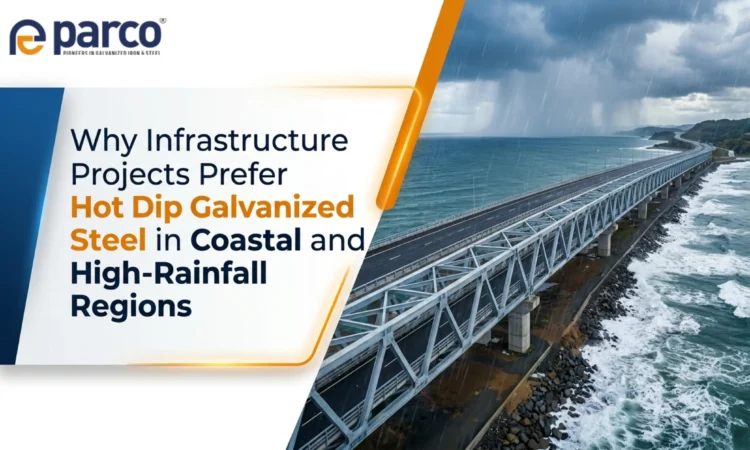
Hot Dip Galvanized Steel Infrastructure is preferred because it provides long-lasting corrosion protection, excellent durability, low maintenance, and superior performance in coastal and high-rainfall regions. The protective zinc coating helps infrastructure assets withstand moisture, humidity, and harsh environmental conditions, extending their service life while reducing repair and maintenance costs.
Why Coastal and High-Rainfall Regions Need Better Steel Protection
Steel is one of the strongest construction materials available, but it is also highly vulnerable to corrosion when exposed to moisture and oxygen over long periods.
In regions experiencing frequent rainfall or located near the coastline, corrosion occurs much faster due to environmental factors such as:
- High humidity throughout the year
- Continuous exposure to rainwater
- Salt-laden coastal air
- Industrial pollution
- Water accumulation on structural members
These conditions gradually weaken steel structures, leading to increased maintenance costs, reduced structural integrity, and shorter service life.
According to the World Corrosion Organization, corrosion costs the global economy over US$2.5 trillion annually, representing approximately 3–4% of global GDP. A significant portion of these losses can be avoided through effective corrosion prevention methods, including hot-dip galvanizing.
For infrastructure projects designed to operate for decades, investing in Infrastructure Steel Protection from the beginning is often more economical than dealing with repeated repairs later.
Key Benefits of Hot Dip Galvanized Steel for Infrastructure
1. Superior Corrosion Protection
The biggest advantage of hot-dip galvanizing is its outstanding corrosion resistance.
The protective zinc coating shields the steel from rain, humidity, pollutants, and salt-laden air, significantly reducing the risk of rust.
This makes galvanized structural steel particularly suitable for:
- Coastal bridges
- Highway infrastructure
- Railway infrastructure
- Transmission towers
- Dam infrastructure
- Electrical infrastructure
- Industrial plants
2. Long Service Life
Infrastructure assets are expected to remain operational for several decades.
Hot-dip galvanized steel offers a significantly longer service life than untreated steel, helping owners minimize repairs and replacements.
This is particularly beneficial for projects where maintenance activities are difficult, expensive, or disruptive.
3. Low Maintenance Requirements
One of the biggest hidden expenses in infrastructure projects is ongoing maintenance.
Painted steel often requires periodic repainting and repairs as coatings deteriorate over time.
Hot-dip galvanized steel, however, requires minimal maintenance because the zinc coating continues protecting the underlying steel for years.
Lower maintenance means:
- Reduced operational costs
- Fewer project interruptions
- Lower labour requirements
- Better asset reliability
4. Excellent Performance in Harsh Weather
India experiences diverse climatic conditions, from coastal humidity to heavy monsoon rainfall.
Hot-dip galvanized steel performs exceptionally well under these conditions because it resists:
- Heavy rainfall
- Moisture
- High humidity
- Temperature fluctuations
- Outdoor weather exposure
This makes it an ideal weather-resistant steel solution for long-term infrastructure projects.
5. Lower Lifecycle Costs
Although hot-dip galvanizing involves an upfront investment, it offers significant savings throughout the structure’s lifespan.
The reduced need for maintenance, repairs, and premature replacement lowers the total cost of ownership.
Instead of focusing only on the initial project cost, engineers increasingly evaluate the lifecycle cost—and galvanized steel consistently proves to be a more economical choice.
Comparison: Hot-Dip Galvanized Steel vs. Painted Steel
| Feature | Hot Dip Galvanized Steel | Painted Steel |
| Corrosion Protection | Excellent | Moderate |
| Service Life | Long | Shorter |
| Maintenance | Minimal | Frequent repainting |
| Performance in Coastal Areas | Excellent | Limited |
| High Rainfall Resistance | Excellent | Moderate |
| Lifecycle Cost | Lower | Higher |
| Surface Protection | Zinc coating | Paint coating |
| Outdoor Durability | High | Medium |
How Hot-Dip Galvanized Steel Supports India’s Growing Infrastructure
India is rapidly investing in highways, railways, metro networks, bridges, renewable energy, ports, airports, and industrial infrastructure through initiatives such as the National Infrastructure Pipeline (NIP) and PM Gati Shakti. However, infrastructure across regions such as Gujarat, Maharashtra, Kerala, Karnataka, Assam, and the North East is often exposed to moisture, humidity, and corrosive conditions.
This makes Hot Dip Galvanized Steel for Infrastructure an effective solution for projects that require long-term durability, corrosion resistance, and reduced maintenance. It is widely used in highways, railway infrastructure, bridges and flyovers, metro projects, transmission towers, solar power plants, industrial facilities, water treatment plants, dams, utilities, and fencing systems.
By providing durable corrosion protection, hot-dip galvanized steel helps extend the service life of critical infrastructure and reduce lifecycle maintenance requirements. Parco Engineers provides reliable hot-dip galvanized steel solutions designed to support India’s growing infrastructure needs with long-term performance and durability.
Real-World Scenario
Scenario: Extending the Life of Coastal Railway Infrastructure
Imagine a railway electrification project passing through a coastal region where overhead line equipment, signal gantries, and cable support structures are exposed to salt-laden air and high humidity every day. If conventional painted steel is used, periodic inspections and repainting become necessary to prevent corrosion, often requiring maintenance blocks that temporarily affect rail operations. By selecting hot-dip galvanized steel during construction, railway authorities can significantly reduce corrosion-related maintenance, improve asset reliability, and extend the service life of critical infrastructure while minimizing operational disruptions. This lifecycle approach demonstrates how material selection during the design phase contributes to safer, more reliable railway networks.
Why Choose Parco Engineers?
At Parco Engineers, we specialize in delivering high-quality Hot Dip Galvanized Steel solutions for infrastructure, industrial, solar, utility, and construction projects across India.
Our expertise in hot-dip galvanizing helps clients achieve:
- Superior corrosion protection
- Long-lasting structural performance
- Consistent coating quality
- Reduced maintenance requirements
- Cost-effective lifecycle solutions
Whether you’re developing highways, bridges, transmission towers, industrial facilities, or renewable energy projects, Parco Engineers provides galvanizing solutions designed to perform in India’s toughest environments.
Conclusion
As India’s infrastructure continues to expand, choosing durable materials has become more important than ever. Coastal regions and high-rainfall areas present unique challenges where corrosion can significantly impact the performance and lifespan of steel structures.
Hot Dip Galvanized Steel for Infrastructure provides an effective solution by offering superior corrosion protection, exceptional durability, and lower maintenance costs. Its protective zinc coating enables bridges, highways, railway infrastructure, transmission towers, dams, and solar projects to withstand harsh weather while maintaining structural integrity.
For organizations seeking long-term value and reliable performance, investing in Hot Dip Galvanized Steel is a smart decision that supports sustainable and resilient infrastructure.
With decades of expertise in corrosion protection, we continues to help infrastructure projects across India build stronger, safer, and longer-lasting steel structures.
FAQs
1. Why is hot-dip galvanized steel preferred for infrastructure projects?
Hot-dip galvanized steel is preferred because it offers superior corrosion protection, exceptional durability, and low maintenance. Its protective zinc coating helps infrastructure withstand harsh weather, extending service life and reducing lifecycle costs.
2. How does galvanized steel perform in coastal regions?
Galvanized steel performs exceptionally well in coastal regions by resisting corrosion caused by salt-laden air, high humidity, and moisture. The zinc coating protects the steel, making it ideal for long-term outdoor infrastructure.
3. What are the benefits of hot-dip galvanized steel in infrastructure projects?
Hot-dip galvanized steel provides excellent corrosion resistance, long service life, minimal maintenance, lower lifecycle costs, and reliable performance in bridges, highways, railways, transmission towers, and other infrastructure projects.
4. How does hot-dip galvanizing reduce lifecycle costs?
Hot-dip galvanizing reduces lifecycle costs by minimizing maintenance, repainting, and repair expenses. Its long-lasting zinc coating protects steel for decades, reducing the need for frequent replacements.
5. How does the zinc coating protect steel from corrosion?
The zinc coating acts as a protective barrier against moisture and oxygen while also providing sacrificial protection. Even if the coating is scratched, the surrounding zinc continues to protect the exposed steel from rust.
6. Why is corrosion protection critical for infrastructure projects?
Corrosion can weaken steel structures, increase maintenance costs, and shorten the lifespan of infrastructure assets. Effective corrosion protection ensures structural safety, improves durability, and reduces long-term operational expenses