How a Hot Dip Galvanizing Plant Works: Step-by-Step Process Explained
Galvanization is a very important process for protecting steel from rust and corrosion. Many items used in construction, agriculture, and infrastructure work rely on this protective process for longevity. In this blog, we will discuss what hot dip galvanizing is and how a hot dip galvanizing plant works in simple terms that are easy to understand.
What Is Hot Dip Galvanizing?
Hot dip galvanizing is a process where steel is immersed in melted zinc to form a protective layer on its surface. This layer is known as a galvanized coating. The steel gets a zinc coating, which protects it from rust, moisture, and environmental damage. The end product is called hot dip galvanized steel. This process is commonly used for fencing products, transmission towers, structural steel products, and other fabricated items.
Why Galvanizing Is Important
Steel is strong, but when it comes into contact with air and water, it rusts. Rusting causes steel to weaken. The steel galvanizing process prevents the steel from rusting by applying a strong galvanized zinc coating to the steel. The zinc coating applied to the steel not only prevents it from rusting but also protects it through sacrificial protection. This means that the zinc coating will rust first, protecting the steel. This is why galvanized steel metal lasts longer than untreated steel.
Overview of a Hot Dip Galvanizing Plant
A Hot Dip Galvanizing Plant is a steel processing plant where steel is cleaned, treated, and then dipped into molten zinc. The plant consists of different tanks and equipment that are arranged in a way to complete the process. If you have ever looked for a “hot dip galvanizing plant near me,” you might have realized that these plants are used by industries such as construction, agriculture, power, and telecom. Now let us learn about the step-by-step process of hot dip galvanization.
Hot Dip Galvanizing Process Steps
The steps involved in the hot dip galvanization process should be followed carefully to get a proper coating.
Step 1: Inspection and Surface Preparation
Before the galvanization process, the steel products undergo inspection. Any oil, grease, dirt, or paint on the steel should be removed before the process. Clean steel is required for proper bonding between zinc and steel. If the steel is not clean, the zinc coating will not adhere properly to the steel.
Step 2: Degreasing
The steel products are immersed in a degreasing tank. This process removes any oil and grease present on the steel surface. After this process, the steel products are washed with water to remove any chemical residue.
Step 3: Pickling
The next process is pickling. In this process, steel is immersed in a mild acid solution, typically hydrochloric or sulfuric acid. This process removes rust and mill scale from the steel surface. This process is a very important part of the steel galvanizing process. If rust is present on the steel, it will impact the result of the galvanization process. After pickling, the steel is again washed with water.
Step 4: Fluxing
The steel is then immersed in a flux solution. The flux prevents oxidation of the steel before it is immersed in the zinc bath. It also assists in ensuring that the molten zinc adheres well to the steel surface. Without fluxing, the coating might not develop evenly. The steel is then dried before the actual galvanizing process.
Step 5: Dipping in Molten Zinc
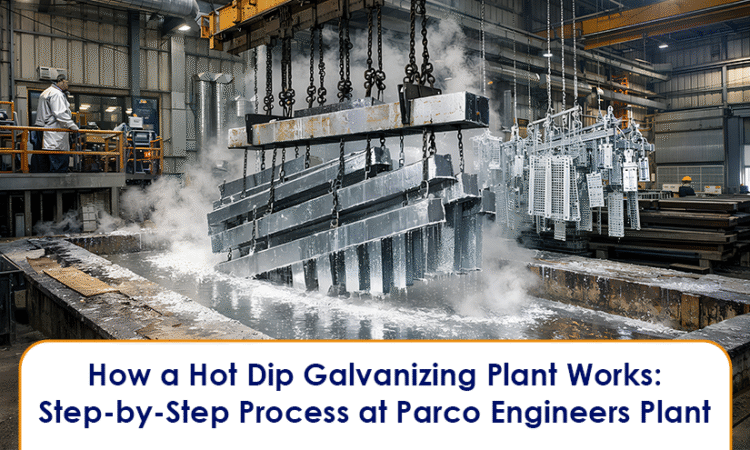
This is the most critical step in the step-by-step hot dip galvanization process. The cleaned steel is immersed in a kettle of molten zinc at a temperature of about 450°C. The zinc reacts with the steel to form a series of layers of a zinc-iron alloy. This produces a strong and durable galvanized coating that is strongly adhered to the surface. This is how steel is hot dip galvanized.
Step 6: Cooling and Solidifying
The steel is then slowly withdrawn from the zinc bath. Excess zinc drips off. The coated steel is then cooled either in the air or water. As the steel cools, the galvanized zinc coating solidifies to form a shiny, protective layer.
Step 7: Inspection and Finishing
After cooling, the galvanized steel metal is inspected for:
- Thickness of coating
- Surface finish
- Uniformity
- Presence of defects
If necessary, minor finishing operations are carried out to remove sharp edges or excess zinc. Only after quality checks is the material ready for shipment.
Advantages of Hot Dip Galvanized Steel
Hot dip galvanizing has several advantages, including:
- Longer service life
- Excellent resistance to corrosion
- Less maintenance
- Economical in the long run
- Complete protection, even at corners and edges
Since the entire product is immersed in melted zinc, even the corners and edges receive complete protection.
Understanding what hot-dip galvanizing is will enable you to appreciate why it is so widely used in the construction industry and in agriculture. The process involved in hot dip galvanizing is cleaning, pickling, fluxing, dipping into molten zinc, cooling, and inspection. Each of these processes is very important in ensuring that the hot dip galvanized steel is strong and durable. At Parco Engineers, quality and accuracy are of utmost importance in every steel galvanizing process that we undertake. Whether it is GI angles, GI channels, or any other structural steel item, proper galvanizing is essential to ensure that it lasts for a long time. A good Hot Dip Galvanizing Plant is the key to making corrosion-resistant steel products that last for many years.