How to Choose the Right GI Angle for Farm Boundary Fencing
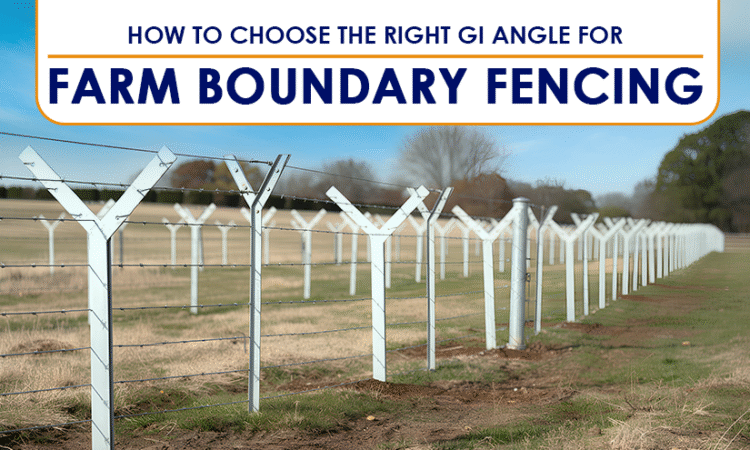
Farm fencing is one of the most crucial investments for any agricultural property. A robust fence will protect your crops, livestock, and property from trespassers and animal invasion. When it comes to choosing the right support structure, selecting the right GI Angle for Fencing is a crucial factor in this regard. In this blog, we will discuss how to choose the right (GI angle) fencing for agriculture in a simple and easy-to-understand manner.
Why GI Angle is Important for Farm Fencing
A fence is only as strong as its supporting posts. The galvanized iron angle for fencing is widely used as supporting posts for fences because of its strength, stability, and long life. GI angles are coated with zinc to resist rust. Agricultural farms are prone to rain, moisture, and weather conditions. If steel is not protected properly, it can rust quickly. This is why galvanized materials are highly preferred for agricultural fencing. Using high-quality fencing angles will ensure that your farm fencing is secure for many years with less maintenance.
Understanding the Galvanization Process
Before selecting the correct GI angle for your farm fencing, it is essential to understand the galvanization process. Galvanization is a process whereby zinc is applied to steel to protect it from rusting. The most effective process is hot dip galvanizing. In this process, the steel angle is immersed in melted zinc to produce a robust and evenly spread galvanized layer. A Hot dip galvanized Angle offers a thicker and more robust protection layer than painted steel. The zinc coating on the galvanized steel is resistant to corrosion even in extreme weather conditions. When constructing long-lasting farm fencing, it is always advisable to select GI angles that have been hot dip galvanized rather than those that have been superficially coated.
Selecting the Right GI Angle Size for Farm Fencing
One of the most frequently asked questions by farmers is about the right GI angle size to be used for farm fencing.
The angle size is determined by:
- The height of the fence
- The type of wire used in the fencing (barbed wire, chain link, or welded mesh)
- The soil type
- The wind load in your region
For standard agricultural land fencing, the commonly used GI angle
- 35 x 35 mm
- 40 x 40 mm
- 50 x 50 mm
- 65 x 65 mm
If your farm is located in an area with strong winds or if you are installing a tall fence, a bigger size angle may be required for better support. Choosing the right size ensures that the fencing does not bend or tilt over time.
Choosing the Right GI angle thickness for fencing
Size, GI angle thickness, and cost are factors that are given the same importance while choosing GI angles for fencing. The thickness of the GI angle determines the strength and lifespan of the fencing post. Thin angles are less expensive but can be prone to bending under pressure or rusting quickly if the coating is of poor quality.
The standard thicknesses available for GI angles are:
- 3 mm
- 4 mm
- 5 mm
- 6 mm
For farm fencing, thicker and more heavily galvanized angles are more suitable for heavy-duty farm fencing. If the farm fencing is designed to enclose livestock or high-value crops, then a thicker angle is a sound investment.
Dependent on the Type of Farm Fencing
The type of farm fencing determines the type of support structure required. The following are some of the most common types of farm fencing:
- Barbed wire fencing
- Chain link fencing
- Solar fencing
- Welded mesh fencing
For light barbed wire fencing, medium GI angles can be used. For chain link or welded mesh fencing, thicker and stronger angles are required. When sourcing materials for your farm fencing, it is essential that the strength of the angle corresponds to the type of fencing material used.
Soil and Environmental Conditions
The soil condition on your farm also plays a major role. If the soil is loose or sandy, deeper installation and stronger angles are required. In coastal or high-moisture areas, corrosion risk is higher. In such cases, ensure the galvanized coating thickness is adequate. A properly done hot dip galvanizing process ensures that the angle remains protected even when partially buried in soil. Always check if the GI angles meet quality standards and have uniform galvanized zinc coating.
Quality of Galvanized Angles
Not all galvanized angles are the same. While purchasing, check for:
- Smooth and even coating
- No peeling or cracks
- Uniform finish
- Proper weight as per specification
A good quality galvanized iron angle for fencing will have a consistent zinc layer and will not show early signs of rust. Buying from a trusted manufacturer ensures that you get properly processed galvanized materials that can withstand outdoor exposure.
Installation and Spacing
Even the best GI Angle for Fencing will fail if not installed properly. Fence posts are usually installed at a spacing of 8 to 10 feet, depending on the fencing type. Corner posts should always be stronger and firmly fixed. Make sure the angle is buried deep enough and set with concrete if required. Proper installation increases the life of your farm fencing system.
Cost vs Long-Term Value
Farmers are often concerned with the cost of fencing. But low-cost angle iron may require more frequent repairs and replacements. Spending more on quality Hot dip galvanized Angle iron will save you money in the long run. It will also give you more value for your money. Durable farm fencing materials will protect your farm, your crops, and your livestock better.
Final Thoughts
Selecting the right GI Angle for Fencing is critical for making long-lasting and strong farm fencing. You must consider the right size, thickness, and quality of galvanization of the angle of iron, as well as the soil type and type of fencing before making your purchase. If you want durable (GI angle) fencing for your agricultural needs, you must choose the right hot dip galvanized angle iron with sufficient galvanization. This will give you long-lasting protection against rust and harsh weather conditions. At Parco Engineers, we know the significance of using high-quality galvanized iron for farm fencing. We know that selecting the right-angle iron for fencing will give you peace of mind and security for years to come. Contact us for further details.