Introduction
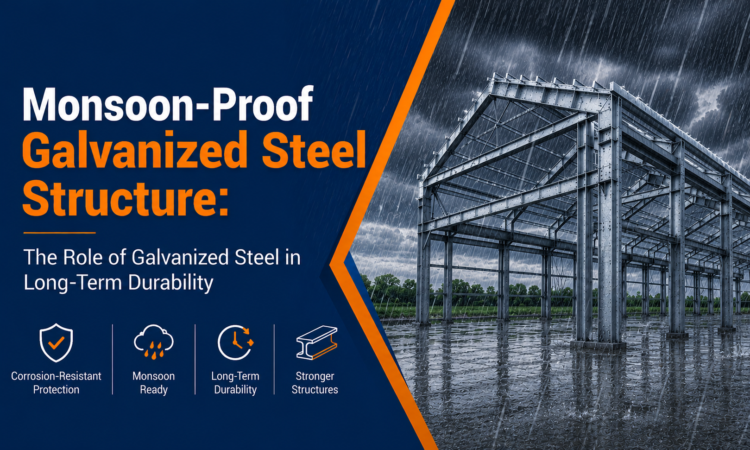
Every monsoon exposes a silent weakness in infrastructure corrosion.
While heavy rainfall and humidity are visible challenges, the real damage often occurs under the surface level. Moisture, oxygen, industrial pollutants, and environmental contaminants continuously attack exposed steel surfaces. Over time, this corrosion degrades structural integrity, increases maintenance costs, and shortens asset life.
This is why infrastructure developers heavily rely on galvanized steel and hot dip galvanized steel when designing assets expected to perform for decades.
At Parco Engineers, galvanization is not viewed as a finishing process—it is considered a long-term asset protection strategy that determines how infrastructure performs throughout its lifecycle.
Why Is Hot Dip Galvanized Steel Ideal for Monsoon Conditions?
Hot dip galvanized steel protects infrastructure by creating a metallurgically bonded zinc layer that shields steel from corrosion. This protective barrier significantly extends service life, reduces maintenance requirements, lowers lifecycle costs, and ensures structural reliability in high-humidity and heavy-rainfall environments.
The Real Cost of Corrosion: A Problem Most Infrastructure Owners Underestimate
Corrosion is not merely a surface issue.
According to global infrastructure studies, corrosion-related damage costs billions annually through maintenance, repairs, replacements, and operational disruptions.
For infrastructure owners, corrosion creates four major challenges:
- Unexpected maintenance expenditure
- Reduced structural lifespan
- Increased safety risks
- Asset downtime and operational interruptions
A transmission tower, industrial shed, highway barrier, is expected to serve for decades, not just a few monsoon cycles.
This is where galvanized steel fundamentally changes the equation.
What Makes Galvanized Steel Different?
Many people assume galvanization is simply a coating applied to steel.
It is much more sophisticated than that.
The galvanizing process creates a metallurgical bond between zinc and steel. Unlike paint, which sits on the surface, zinc becomes part of the steel structure itself.
This results in:
- Superior corrosion protection
- Self-healing characteristics
- Greater impact resistance
- Long-term durability
The resulting galvanized coating acts as both a physical and electrochemical shield against environmental attack.
Why Monsoon Conditions Accelerate Corrosion
Monsoon environments create ideal conditions for oxidation.
Several factors contribute:
Continuous Moisture Exposure
Water remains in contact with steel surfaces for extended periods
High Humidity Levels
Even when rain stops, atmospheric moisture continues to support corrosion reactions.
Pollutants and Industrial Contaminants
Sulphur compounds, chlorides, and airborne pollutants accelerate steel degradation.
Coastal Conditions
Salt-laden air dramatically increases corrosion rates.
This is why conventional painted steel often requires repeated maintenance cycles, whereas hot dip galvanized steel continues performing for decades.
The Science Behind Hot Dip Galvanized Steel
The effectiveness of galvanization lies in zinc.
When steel is immersed in molten zinc during the galvanizing process, multiple zinc-iron alloy layers form.
These layers create a highly durable galvanized zinc coating that provides:
- Barrier Protection : The coating prevents water and oxygen from reaching the steel.
- Sacrificial Protection : Even if the surface is scratched, zinc corrodes first, protecting the underlying steel.
- Uniform Coverage : Internal cavities, edges, corners, and difficult-to-access areas receive protection. This combination makes hot-dip galvanization one of the most effective corrosion prevention technologies available.
Why Engineers Specify Hot Dip Galvanized Steel for Critical Infrastructure
Infrastructure failures rarely occur because of poor design.
More often, they result from environmental degradation over time.
Engineers specify hot dip galvanized steel because it offers predictable long-term performance.
Applications include:
- Power transmission towers
- Highway crash barriers
- Industrial structures
- Warehouses
- Renewable energy installations
These structures are expected to remain operational for decades while facing continuous environmental exposure.
Galvanized Steel vs Painted Steel: The Lifecycle Perspective
Most procurement decisions focus on upfront cost.
Experienced engineers focus on lifecycle cost.
| Factor | Hot Dip Galvanized Steel | Painted Steel |
| Initial Protection | Excellent | Moderate |
| Maintenance Frequency | Low | High |
| Recoating Requirement | Rare | Frequent |
| Service Life | 30–50+ Years | 5–15 Years |
| Lifecycle Cost | Lower | Higher |
A lower purchase price often results in higher ownership costs.
Galvanization shifts spending from reactive maintenance to proactive protection.
The Role of a Modern Hot Dip Galvanizing Plant
The quality of galvanization directly affects infrastructure performance.
A world-class hot dip galvanizing plant ensures:
- Consistent coating thickness
- Proper zinc adhesion
- Complete surface coverage
- Compliance with IS and ASTM standards
At Parco Engineers, quality control measures ensure that every galvanized component meets demanding infrastructure requirements, particularly for outdoor and high-exposure environments.
Conclusion
The importance of galvanized steel extends far beyond corrosion protection.
It represents a strategic investment in durability, reliability, and long-term asset performance. In monsoon-prone regions, where moisture exposure is unavoidable, hot dip galvanized steel provides the protection necessary to ensure infrastructure remains safe, functional, and cost-effective for decades.
As infrastructure projects increasingly prioritize lifecycle value over short-term savings, galvanization will continue to serve as one of the most important technologies for building resilient, future-ready structures.
FAQ
How long does hot dip galvanized steel last?
Depending on environmental conditions, hot dip galvanized steel can provide corrosion protection for 30–50 years or longer without major maintenance.
What is the difference between galvanized steel and painted steel?
Galvanized steel uses a zinc coating bonded to the steel surface, while paint only forms a surface layer. Galvanization typically offers superior durability and corrosion resistance.
Is galvanized steel suitable for coastal areas?
Yes. Hot-dip galvanization provides excellent protection against salt-laden air and high humidity common in coastal environments.
Why is galvanization important during monsoon seasons?
Monsoon conditions accelerate corrosion through prolonged moisture exposure. Galvanization creates a protective barrier that significantly slows corrosion.
Which industries benefit from galvanized materials?
Power transmission, transportation, infrastructure, manufacturing, renewable energy, and industrial construction sectors all benefit significantly from galvanized materials.