
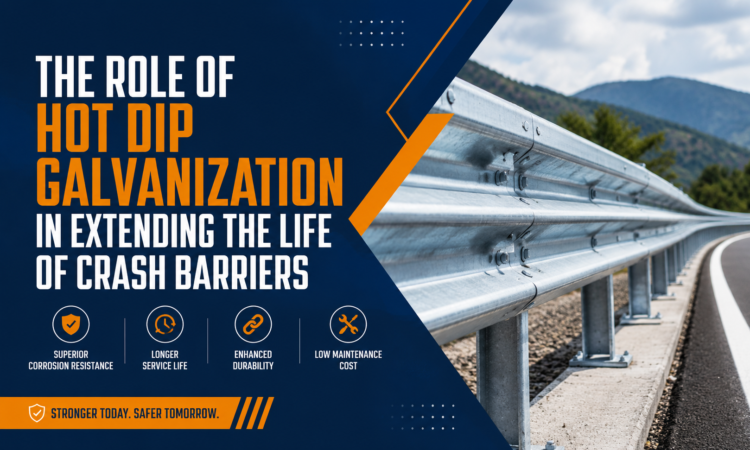
The Role of Hot Dip Galvanization in Extending the Life of Crash Barriers
Road infrastructure plays a significant role in safer transportation and reducing the impact of accidents on highways and expressways. Among all, the most essential safety installations include a crash barrier, designed to absorb impact, redirect vehicles, and minimize the severity of collisions. However, these structures are constantly exposed to harsh environmental conditions such as rain, humidity, pollution, and changing temperatures. This may affect the durability of crash barriers due to corrosion without appropriate protection.
This is where hot dip galvanization becomes essential. By providing a durable protective zinc coating, hot dip galvanization enhances the durability and performance of crash barriers, making them suitable for long-term use in demanding environments.
Crash Barriers and Their Significance
Crash Barriers and Their Significance
Road crash barriers are the safety structures fitted on the roads and highways that prevent a vehicle from drifting away from the path of travel or into the opposing lane.
These barriers, which form part of the road’s protective features, are designed to resist and absorb the collision forces of a vehicle when it hits the barrier.
Modern metal beam crash barriers have become the most utilized type of barriers in highways, due to their durability, malleability, and efficiency in handling high-speed impacts. A proper road crash barrier should not only protect drivers and occupants, but pedestrians, adjacent buildings, and critical infrastructure.
Since these barriers remain exposed to outdoor conditions 24/7, ensuring long-term corrosion resistance becomes a top priority. This is where Galvanization comes in.
Why is Galvanization Used in Crash Barriers
Steel is extensively used for manufacturing crash barriers due to its high tensile strength, durability, and resistance to impacts.
At the same time, unprotected steel is highly vulnerable to corrosion when it is exposed to moisture and pollutants.
In order to eliminate this problem, galvanized steel barriers are often used in today’s construction. Galvanization means that the surface of the metal is coated with zinc, thus making the metal resistant to corrosion.
One of the most efficient techniques to protect a steel crash barrier from corrosion is hot dip galvanization. It is a method based on creating a metallurgical bond between the zinc and the metal, which does not allow for any contact between the steel surface and the elements of the environment.
Benefits associated with the use of galvanized steel barriers include:
- High resistance to corrosion
- Extended service life
- Minimal maintenance needs
- Superior performance in marine and humid areas
- More efficient throughout their service life
For this reason, galvanized steel is widely recognized as the best material to be used in crash barriers along highways.
How Hot Dip Galvanization Extends Crash Barrier Life
One of the main advantages of hot dip galvanizing, which makes it popular, is its capability to prolong the life span of crash barriers in harsh conditions.
Hot dip galvanizing includes dipping steel components into liquid zinc at high temperature to form various alloys of zinc iron attached tightly to the metal substrate. The galvanized coating becomes a part of the metal as opposed to common paint-based coatings.
Here’s how hot dip galvanization extends crash barrier life:
1. Superior Corrosion Resistance
Zinc coating offers good protection against moisture, air, and any other elements that might cause the steel to rust. The barrier will not have any rust despite harsh conditions in terms of rainfall and industrial emissions.
2. Sacrificial Protection
Zinc acts as a sacrificial metal. Even if the surface gets scratched or damaged, the zinc corrodes first instead of the steel underneath. This self-protective property helps maintain the strength of metal beam crash barriers over long periods.
3. Uniform Coating Coverage
Hot dip galvanization provides complete coverage, including edges, corners, and difficult-to-reach areas. This ensures comprehensive protection throughout the entire highway crash barrier structure.
4. Reduced Maintenance Costs
Traditional coatings often require frequent repainting or repairs. In contrast, galvanized steel barriers require minimal maintenance, reducing long-term operational expenses for infrastructure authorities and contractors.
5. Resistance to Extreme Weather Conditions
Galvanized steel road safety barriers prove their worth in the face of harsh weather elements such as heavy rains and humidity.
Lifespan of Hot Dip Galvanized Crash Barriers
Hot dip galvanized roadside crash barriers have a considerably longer life span than their ungalvanized counterparts. According to environmental conditions and galvanized coating thickness, galvanized roadside crash barriers could last up to decades.
Moderate environments will enable the hot dip galvanized steel barriers to remain functional and effective for at least 30 to 50 years and beyond. Even harsh environments will allow the galvanized coating to withstand corrosion over a significant period of time.
These long-lasting qualities make hot dip galvanized steel barriers an excellent choice for road safety barriers for infrastructure development firms and governmental agencies.
Corrosion Protection Methods for Crash Barriers
Corrosion is a major problem when it comes to ensuring the strength of road safety barriers. There are many approaches that are applied in practice, and among them there are
- Painting and powder coating
- Epoxy coatings
- Weather resistant steel
- Hot dip galvanization
Among these, hot dip galvanization remains one of the most trusted and widely adopted corrosion protection methods for crash barriers because of its durability, cost-effectiveness, and low maintenance requirements.
Whereas protective coatings can suffer from peeling or cracking during their service life, galvanized coatings provide continuous protection regardless of harsh environmental conditions. Therefore, galvanized coatings make an ideal choice where safety and cost-efficiency are paramount.
Usage of Crash Barriers Across Infrastructure Projects
Crash barriers are used extensively across multiple infrastructure applications to improve road safety and traffic management.
Common usage areas include:
- National highways and expressways
- Bridges and flyovers
- Mountain roads and sharp curves
- Industrial zones and logistics parks
- Urban roads and medians
- Toll plazas and high-speed corridors
Metal Beam Crash Barriers prove to be particularly useful in places with fast-moving vehicles, because of their robust nature coupled with the protection provided by hot-dip galvanization.
Conclusion
With the ongoing development of road infrastructure, there is an increasing need for reliable and resilient crash barriers that will serve this purpose. Hot dip galvanization is an essential process in optimizing the effectiveness of such systems and increasing their reliability and service life.
By offering superior corrosion resistance, reduced maintenance, and long-term durability, galvanized steel barriers provide an efficient solution for modern highway infrastructure. No matter where the road safety barriers are used, be it on highways, bridges, or industrial roads, it can serve its function efficiently after proper galvanization.
For infrastructure projects focused on long-term safety and performance, investing in high-quality hot dip galvanized crash barriers is a practical and sustainable choice.
FAQ
Why are galvanized crash barriers better than painted ones?
Galvanized crash barriers offer better corrosion resistance, longer lifespan, and lower maintenance than painted barriers.
Are these barriers suitable for coastal or high-humidity areas?
Yes, galvanized crash barriers are ideal for coastal and humid areas due to their strong anti-corrosion protection.
Are galvanized crash barriers cost-effective?
Yes, they reduce maintenance and replacement costs, making them a long-term cost-effective solution.
Where are metal beam crash barriers used?
They are used on highways, bridges, flyovers, medians, industrial roads, and parking areas for road safety.
How to choose reliable crash barrier manufacturers?
Choose manufacturers with certified quality standards, strong galvanization expertise, and proven infrastructure project experience.

One Reply to “The Role of Hot Dip Galvanization in Extending the Life of Crash Barriers”
Comments are closed.